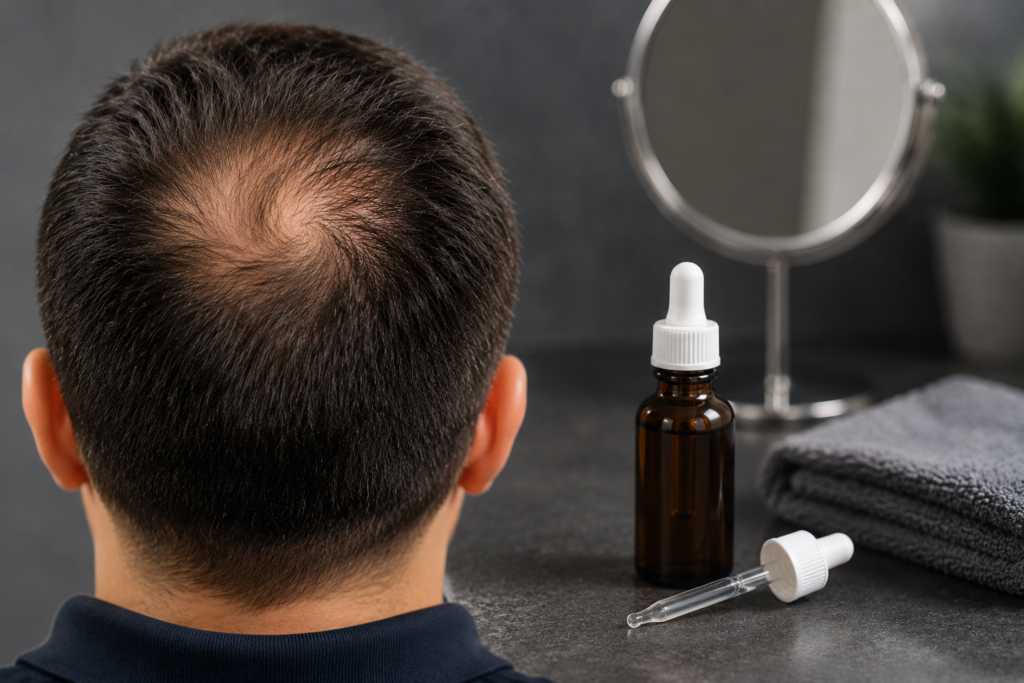
Yes. Of all the areas on the scalp affected by androgenetic alopecia, the crown is where minoxidil has its strongest, most consistent, and most extensively documented track record. This is not a hedge or a “it depends” answer — the original clinical trials that got minoxidil approved for hair loss were conducted almost entirely on crown thinning, and the results from that research remain the backbone of everything we know about how well this treatment works.
That said, “works well” and “works the same for everyone” are two different statements. This article covers why the crown responds so favorably, what level of improvement is realistic, and the specific situations where even crown treatment has its limits.
Why the Crown Specifically
There are two separate reasons the crown — also called the vertex — has become the benchmark area for minoxidil’s effectiveness, and they are worth separating because one is about biology and the other is about how research happened to be designed.
The biological reason: crown follicles in many men with androgenetic alopecia tend to miniaturize somewhat later in the overall progression compared to the hairline and temples, which are often the very first areas affected by DHT. This means that by the time a man notices crown thinning and starts treatment, those follicles have frequently had less cumulative DHT exposure than his temple follicles — making them, on average, better candidates for a treatment that depends on follicles still being active rather than fully dormant.
The research reason: when the original large-scale minoxidil trials were designed in the 1980s, researchers chose the crown as the primary measurement site, largely because it is easier to photograph and measure consistently from directly above than the hairline, which varies more in shape and is harder to standardize across study participants. Decades of subsequent research built on that initial framework, which is partly why crown-specific data is so much more extensive than hairline-specific data — not necessarily because minoxidil is biologically incapable of working elsewhere, but because that is where the measurement tools and historical data happen to be concentrated.
What the Numbers Actually Look Like
Clinical trials measuring crown response to topical minoxidil 5% have found that a substantial majority of men using it consistently for a year show measurable increases in hair count within the treated area, with average increases in the range of dozens of additional hairs per square centimeter compared to baseline — a meaningful, visible difference rather than a marginal statistical one.
Beyond hair count, men using minoxidil at the crown commonly report:
- Reduced visibility of scalp through hair under normal indoor lighting
- Thicker individual strands, not just more of them
- A “filling in” appearance at the edges of a thinning patch, where the transition between dense and thin hair becomes less abrupt
- Less dramatic results in the absolute center of a long-standing bald spot compared to the surrounding, less-affected areas
That last point matters and is worth dwelling on, because it explains a pattern many men notice and find confusing: improvement tends to be strongest at the margins of a bald area and weakest in the center. This follows directly from follicle viability — the center of a long-established bald spot usually contains the most severely miniaturized or dormant follicles, while the surrounding, more recently thinning areas still have active follicles that respond more readily.
The Three Crown Scenarios, and What to Expect in Each
Not all “crown balding” describes the same situation, and the realistic outcome differs meaningfully depending on which of these you are actually dealing with.
Diffuse thinning with no clear bald spot. The crown looks less dense than it used to, but there is no defined area of visible scalp — just an overall reduction in coverage. This is the scenario where minoxidil tends to perform best and most predictably, since the follicles involved are generally still active across the whole area.
A defined thinning patch with visible scalp, but recent onset. A bald or near-bald area has emerged within the last one to two years. Results here are still generally favorable, particularly at the edges of the patch, though the very center may respond more slowly or modestly.
A long-standing, fully bald crown. The area has been smooth and hairless for many years. This is where expectations need the most adjustment — minoxidil is far less likely to produce visible regrowth in a zone where follicles have likely been dormant for an extended period, though it may still help preserve hair in the surrounding, less-affected scalp.
Crown vs Hairline: A Brief but Important Comparison
It is worth being direct about this since it comes up constantly: minoxidil’s track record at the crown is simply stronger than its track record at the hairline and temples. This is not a reason to avoid using it on the hairline if that is where your concern lies — many men do see worthwhile improvement there — but if you are choosing where to focus realistic expectations, the crown is the more favorable bet based on the available evidence.
For men dealing with thinning in both areas simultaneously, which is common as androgenetic alopecia progresses, it is reasonable to expect more visible improvement at the crown within the same timeframe than at the hairline, even using identical treatment consistency in both areas.
Application Technique Specific to the Crown
The crown presents a practical application challenge the hairline does not: you cannot easily see what you are doing. A few adjustments improve consistency:
- Use a mirror behind you, or a second mirror angled to show the crown reflected in a front-facing mirror. Applying blind to an area you cannot see leads to inconsistent coverage over time.
- Part the hair in multiple directions before applying. The foam or liquid needs to reach the scalp, not just sit on top of hair strands. A single straight-line part often misses follicles on either side.
- Avoid concentrating product in one spot. It is tempting to apply heavily to the center of a bald patch, but spreading the application slightly beyond the visibly thin area treats the follicles at the margins that are most likely to respond.
- Let it dry fully before lying down or putting on a hat. The crown is more prone to product transfer onto pillows or hat linings simply due to head position during the day and at night.
Common Misconceptions Worth Correcting
“If it hasn’t worked by three months, it won’t work.” Crown response, like all minoxidil response, typically requires four to six months before any visible change, and up to twelve months for the fuller picture. Three months is too early to draw conclusions in almost every case.
“Minoxidil only works on the crown, not anywhere else.” Not accurate. The crown simply has the strongest and most extensive evidence base; minoxidil can and does help at the hairline and temples too, just with results that are typically more modest and variable.
“A completely bald crown means there’s nothing left to treat.” Partially true, partially not. The fully bald center may indeed have little remaining follicle activity, but the gradually thinning border around it usually still does, and that border is exactly where minoxidil tends to show its best results.
“Switching to a higher concentration always gets better results.” The 5% formulation outperforms the 2% version in most studies, but going beyond 5% has not been shown to provide additional benefit and may simply increase the likelihood of scalp irritation without a corresponding improvement in results.
Frequently Asked Questions
How long does minoxidil take to work on the crown specifically?
Most men begin noticing early signs of improvement between months four and six, with more substantial results visible by months six to twelve. This is broadly consistent with minoxidil’s general timeline, though some studies suggest crown response may emerge slightly faster on average than hairline response.
Can minoxidil completely regrow a bald spot on the crown?
For recently developed thinning, partial to substantial improvement is achievable for many men. For a long-standing, fully bald area, complete regrowth is unlikely, though improvement at the surrounding margins often still occurs.
Why does my crown respond better to minoxidil than my hairline?
Crown follicles are often less severely miniaturized than hairline follicles at the point treatment begins, since the hairline and temples tend to be affected earlier in the progression of androgenetic alopecia for most men. This generally gives crown follicles a head start in terms of remaining viability.
Should I use minoxidil only on my crown if that is my main concern?
You can apply it specifically to the affected area, but it is worth covering slightly beyond the visibly thinning zone to treat follicles at the margins that may be in earlier stages of miniaturization and not yet visibly affected.
Is combining minoxidil with finasteride worth it specifically for crown balding?
Generally yes. Since the crown already responds well to minoxidil alone, adding finasteride to address the underlying DHT-driven miniaturization tends to produce better long-term preservation and often more pronounced regrowth than either treatment used alone.
Final Thoughts
If you are dealing with crown balding specifically, you are in the scenario where minoxidil has the most evidence, the most consistent results, and the clearest track record of any area on the scalp. That does not make it guaranteed or instant, and a long-standing, fully bald center still presents real limits — but for diffuse thinning or recently developed crown loss, this is about as favorable a starting position as exists in non-surgical hair loss treatment.
The practical advice does not change much from anywhere else on the scalp: apply consistently, cover slightly beyond the visible thinning, give it a genuine six to twelve months before judging the outcome, and track progress with photos rather than daily mirror checks. The crown rewards that patience more reliably than almost anywhere else minoxidil is used.
Written by ModernHairRecovery Editorial Team.