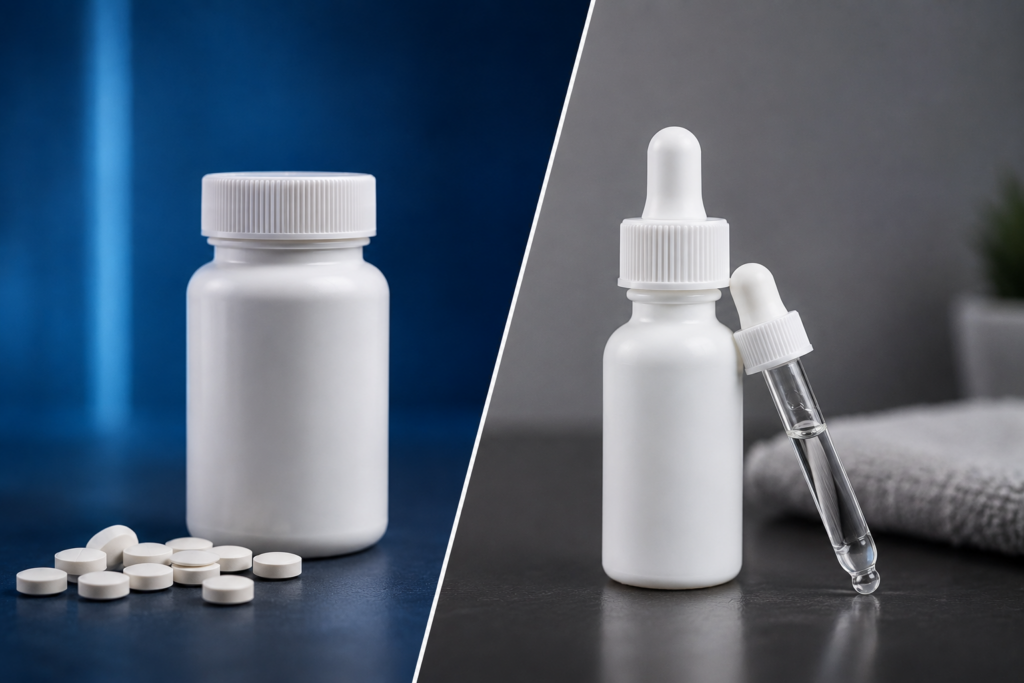
Minoxidil has been one of the most widely used treatments for male pattern baldness for decades. While topical Minoxidil has long been available over the counter, low-dose oral Minoxidil has become increasingly popular as an alternative for men who want a simpler routine or who have not achieved the desired results with topical treatment.
This growing interest raises an important question:
Is oral Minoxidil better than topical Minoxidil?
The answer depends on several factors, including the severity of your hair loss, your medical history, your tolerance for potential side effects, and your treatment goals.
Both forms of Minoxidil can be effective, but they differ in how they work, their safety profiles, convenience, cost, and the type of patient who is most likely to benefit.
What Is Minoxidil?
Minoxidil is a medication that helps stimulate hair growth and slow the progression of androgenetic alopecia, commonly known as male pattern baldness.
Although its exact mechanism is not fully understood, research suggests that Minoxidil prolongs the anagen (growth) phase of the hair cycle, improves blood flow around hair follicles, and may increase the size of miniaturized follicles.
Unlike finasteride, Minoxidil does not reduce DHT levels. Instead, it works by creating a more favorable environment for hair growth.
Topical Minoxidil
Topical Minoxidil is applied directly to the scalp, usually once or twice daily depending on the product and your healthcare provider’s recommendations.
Advantages
- FDA-approved for male pattern baldness.
- Available without a prescription in many countries.
- Minimal systemic absorption compared with oral therapy.
- Suitable for long-term use for many men.
Disadvantages
- Requires consistent daily application.
- Can leave hair feeling greasy depending on the formulation.
- May cause scalp irritation, itching, or flaking.
- Missing applications can reduce effectiveness.
Oral Minoxidil
Oral Minoxidil is taken as a tablet. It was originally developed to treat high blood pressure, but lower doses are now prescribed off-label by many clinicians for hair loss.
Because it circulates throughout the body, oral Minoxidil may stimulate hair growth in multiple areas, not just the scalp.
Advantages
- Simple once-daily routine.
- No residue or scalp irritation.
- Useful for men who struggle with topical application.
- May benefit individuals who did not respond well to topical Minoxidil.
Disadvantages
- Requires a prescription.
- Potential for systemic side effects.
- Needs medical supervision.
- Not appropriate for everyone.
How Effective Is Oral Minoxidil Compared with Topical?
Current research suggests that both oral and topical Minoxidil can improve hair density in men with androgenetic alopecia.
Some studies indicate that low-dose oral Minoxidil may produce similar—or, in certain cases, greater—improvements than topical formulations. However, individual response varies considerably, and no treatment guarantees regrowth.
In general, both options are more effective when treatment begins before extensive follicle miniaturization has occurred.
Side Effects: Oral vs Topical Minoxidil
Topical Minoxidil
- Scalp irritation
- Dryness
- Itching
- Flaking
- Temporary shedding during the first few weeks for some users
Oral Minoxidil
- Increased body hair growth (hypertrichosis)
- Swelling in some individuals
- Changes in heart rate
- Lightheadedness
- Fluid retention
Although low-dose oral Minoxidil is generally well tolerated when prescribed appropriately, systemic side effects are possible and should not be ignored.
Which Treatment Is More Convenient?
Convenience is an important factor in long-term success.
Many men prefer oral Minoxidil because taking a daily tablet is often easier than applying a liquid or foam every morning and evening.
On the other hand, men who prefer to avoid systemic medication may be more comfortable with topical treatment despite the extra effort required.
When Can You Expect Results?
Hair growth is a gradual process regardless of which form you choose.
A typical timeline looks like this:
- Weeks 2–8: Some users experience temporary shedding.
- Months 3–4: Early signs of stabilization or new growth may appear.
- Months 6–12: Many users notice more visible improvements.
- After 12 months: Results often reach their peak, although continued use is usually necessary to maintain them.
Can Oral and Topical Minoxidil Be Combined?
Combining oral and topical Minoxidil is not routinely necessary for most men.
Some specialists may recommend combination therapy in selected cases, but this approach may increase the likelihood of side effects and should only be considered under medical supervision.
Cost Considerations
Costs vary depending on your location, pharmacy, and healthcare provider.
- Generic topical Minoxidil: approximately $15–$40 per month.
- Brand-name topical products: approximately $30–$70 per month.
- Low-dose oral Minoxidil: approximately $10–$40 per month for generic tablets, although consultation costs may apply.
Prescription appointments and follow-up monitoring may increase the overall cost of oral therapy.
Who Is Topical Minoxidil Best For?
- Men with early-stage male pattern baldness.
- Those who prefer an FDA-approved topical treatment.
- Men who want to minimize systemic exposure.
- Individuals comfortable with daily scalp application.
Who Is Oral Minoxidil Best For?
- Men who dislike applying topical products.
- Those who experienced scalp irritation with topical Minoxidil.
- Patients who are appropriate candidates after medical evaluation.
- Men looking for a simpler daily routine.
Pros and Cons
Topical Minoxidil
Pros
- Minimal systemic absorption.
- Available without a prescription in many regions.
- Well studied for male pattern baldness.
Cons
- Daily application required.
- Possible scalp irritation.
- Can be messy.
Oral Minoxidil
Pros
- Very convenient.
- No scalp residue.
- May help men who did not respond well to topical treatment.
Cons
- Prescription required.
- Potential systemic side effects.
- Requires medical supervision.
Frequently Asked Questions
Is oral Minoxidil more effective than topical Minoxidil?
Some studies suggest it may provide similar or greater improvements in certain men, but individual response varies.
Is oral Minoxidil safer?
Not necessarily. Oral Minoxidil has greater systemic exposure and therefore a different side-effect profile than topical formulations.
Can I switch from topical to oral Minoxidil?
Some men do, but any change in treatment should be discussed with a qualified healthcare professional.
Will I lose my hair if I stop Minoxidil?
Yes. Hair maintained by Minoxidil is typically lost gradually after discontinuing treatment.
Can I use Minoxidil with Finasteride?
Yes. Many men combine Minoxidil with finasteride because the two treatments work through different mechanisms and may provide complementary benefits.
Final Thoughts
Choosing between oral and topical Minoxidil is not about finding a universally “better” treatment—it is about finding the option that best matches your needs.
Topical Minoxidil remains an excellent first-line treatment for many men because it has been extensively studied and has limited systemic absorption. Oral Minoxidil offers greater convenience and may be an effective alternative for selected patients, but it requires medical supervision due to the possibility of systemic side effects.
Whichever option you choose, consistency is essential. Hair growth takes time, results vary between individuals, and neither form of Minoxidil provides a permanent cure for male pattern baldness. Starting treatment early and maintaining realistic expectations will give you the best chance of preserving your hair over the long term.
Written by ModernHairRecovery Editorial Team.