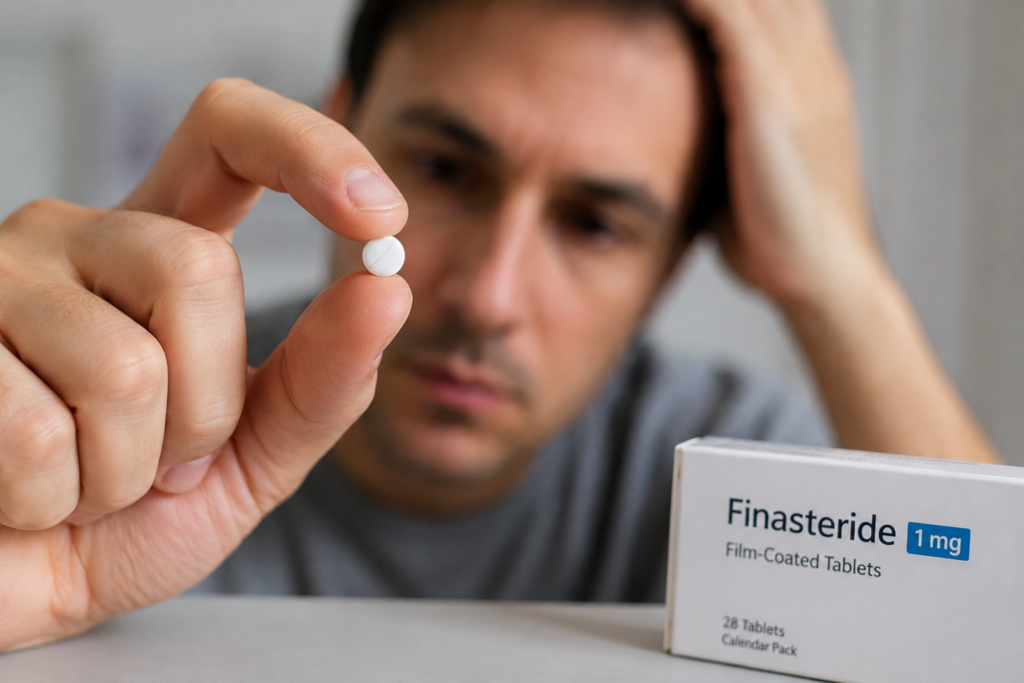
Maybe you have been on finasteride for a few years and you are wondering if you still need it. Maybe a side effect made you reconsider. Maybe you are simply curious what would happen before you commit to taking a pill indefinitely. Whatever brought you here, the question is a fair one, and it deserves a clear, specific answer rather than a vague warning.
The short version: stopping finasteride reverses the hormonal change it was creating, and the hair loss process that was being held back resumes. It is not more complicated than that biologically, but the practical details — how fast, how much, and whether it is reversible if you change your mind — are worth understanding clearly before you decide.
The Core Mechanism: Why Stopping Has an Effect at All
Finasteride works by inhibiting 5-alpha reductase, the enzyme responsible for converting testosterone into DHT. While you are taking it, your DHT levels remain suppressed — typically reduced by 60 to 70 percent compared to baseline with the standard 1mg dose. That suppression is what protects hair follicles from the miniaturization process DHT drives in men with androgenetic alopecia.
Finasteride does not alter your genetics or permanently change how your body produces or processes DHT. It works only while it is active in your system. Once you stop taking it, the enzyme it was inhibiting returns to normal function, and DHT production returns to your baseline level — the level your body would have been producing all along without the medication.
How Quickly Does DHT Return to Baseline?
Faster than most people expect. Finasteride has a relatively short half-life — roughly five to six hours in most men — meaning it clears from the bloodstream quickly once you stop taking it. DHT levels begin rising within days and typically return to pre-treatment baseline within one to two weeks.
This is an important distinction from the visible effects on your hair, which take considerably longer to show up. The hormonal reversal happens fast. The follicle-level consequences of that reversal unfold over months, because hair growth and shedding operate on the timeline of the hair cycle, not the timeline of hormone clearance.
The Realistic Timeline After Stopping
| Timeframe | What Is Happening |
|---|---|
| Days 1–14 | Finasteride clears from the bloodstream; DHT levels rise back to baseline |
| Weeks 2–8 | No visible hair change yet for most men; follicles still in their current cycle |
| Months 2–4 | Follicles that were being protected begin resuming the miniaturization process; shedding may become noticeable |
| Months 4–8 | Hair density gradually declines as the effect of finasteride fades from the follicles |
| Months 8–12 | Hair loss typically stabilizes at a level consistent with where it would be had finasteride never been used, accounting for time passed |
Men who used finasteride for longer periods, or who experienced significant improvement while on it, often notice the reversal more dramatically simply because there is more gained benefit to lose. Men who used it briefly or saw modest results to begin with may notice a less pronounced change.
Do You Lose More Than You Would Have Without Treatment?
No — and this is one of the most reassuring and consistently misunderstood facts about stopping finasteride. The hair loss that resumes after stopping is the same process that would have occurred all along without treatment, simply picking back up from where it left off, plus whatever additional time has passed.
Finasteride does not cause a “rebound” that accelerates hair loss beyond its natural genetic trajectory. There is no evidence that follicles are somehow worse off for having been temporarily protected and then exposed to DHT again. What happens is a return to baseline progression, not an acceleration past it.
The psychological experience can feel different from this biological reality. A man who maintained a full head of hair for five years on finasteride, then stops and sees noticeable thinning within a year, understandably feels like he has lost a lot quickly. In reality, he is simply experiencing the five years of progression that finasteride had been delaying, compressed into a shorter visible window — not new damage caused by stopping.
What About Stopping Due to Side Effects?
For the majority of men who experience sexual side effects on finasteride — reduced libido, erectile difficulty, or decreased ejaculate volume — those effects typically resolve within days to weeks of stopping, in line with how quickly DHT and other hormone levels return to baseline.
A smaller, more contested group of men report symptoms persisting well beyond this expected recovery window, sometimes referred to as post-finasteride syndrome. The scientific and clinical community has not reached firm consensus on how common this is or what the underlying mechanism might be, and research in this area is ongoing. If you experienced side effects and they do not resolve within a few weeks of stopping, this is a situation that genuinely warrants a conversation with a doctor rather than general reassurance, since it falls outside the well-established and expected pattern.
Can You Restart Finasteride Later?
Yes, and this is generally straightforward. Restarting finasteride after a break typically restores DHT suppression within the same one-to-two-week window as the first time, and the protective effect on follicles resumes from there. There is no clear evidence that finasteride becomes less effective after stopping and restarting, though follicles that became significantly more miniaturized during the time off may take longer to show improvement than they would have if treatment had simply continued without interruption.
That said, repeated stopping and starting is not an efficient strategy if your goal is consistent hair preservation. Each gap allows some additional progression that a continuous regimen would have prevented. If you are uncertain about commitment, it is worth having that conversation honestly with yourself or a doctor before starting, rather than cycling on and off repeatedly.
Is There a Safe Way to Taper Off?
Unlike some medications that require gradual tapering to avoid withdrawal effects, there is no strong evidence that tapering finasteride produces a meaningfully better outcome than stopping at the standard dose. The hormonal reversal is tied to the drug clearing your system, not to how abruptly you discontinue it. Some men choose to step down to taking it every other day for a period before stopping entirely, largely for psychological comfort rather than because of documented physiological benefit.
If you are stopping due to side effects, simply discontinuing as directed by your prescribing doctor is the standard approach, and most men do not require a special tapering protocol.
A Practical Example
A 33-year-old man has taken finasteride consistently for four years. His hairline, which was receding when he started, has remained stable, and his crown shows mild improvement from where it started. He decides to stop, partly due to the ongoing cost and partly to see what happens to his hair without it.
For the first two months, nothing visibly changes. Around month three, he notices slightly more shedding than usual. By month seven, his hairline has receded somewhat further than where it had been stable for years, and his crown has lost the mild improvement it had gained. By month ten, things have settled into a new, somewhat less dense baseline — roughly where his hair loss would likely be if he had never started treatment four years earlier, given the additional time that has now passed.
He has not been harmed by having used finasteride. He has simply returned to his natural trajectory, four years further along than when he started — which is exactly what the biology predicts.
Frequently Asked Questions
How long after stopping finasteride does hair start falling out?
Most men notice increased shedding beginning around two to four months after stopping, once follicles that were being protected begin resuming the miniaturization process driven by rising DHT levels.
Will my hair loss be worse than if I had never taken finasteride?
No. Stopping returns your hair loss to approximately the trajectory it would have followed without treatment, adjusted for the time that has passed. There is no evidence that finasteride causes accelerated loss after discontinuation.
Do side effects go away after stopping?
For most men, yes, typically within days to a few weeks as hormone levels return to baseline. A smaller group report persistent symptoms beyond this window, which warrants medical evaluation rather than assuming it will resolve on its own.
Can I restart finasteride after stopping for a while?
Yes. Restarting generally restores DHT suppression within one to two weeks, similar to starting for the first time. Follicles that became more miniaturized during the time off may take longer to show improvement than if treatment had never stopped.
Should I taper off finasteride instead of stopping suddenly?
There is no strong evidence that tapering produces a better outcome than stopping at the standard dose. The reversal is tied to how quickly the drug clears your system, which happens on a similar timeline regardless of how you discontinue it.
Final Thoughts
Stopping finasteride does exactly what the biology predicts: DHT returns to baseline within about two weeks, and the hair loss process that was being held back gradually resumes over the following months, typically becoming noticeable between months two and four and stabilizing within about a year. It is not damage, it is not an accelerated worse-case scenario, and it is not irreversible if you decide to restart.
What it is, plainly, is the removal of an ongoing intervention from a condition that was always going to progress without it. If you are considering stopping, the useful question is not whether something dangerous will happen — the evidence says it will not — but whether you are comfortable losing the specific benefit finasteride has been providing. That is a much more answerable question, and knowing the real timeline makes it considerably easier to answer honestly.
Written by ModernHairRecovery Editorial Team.