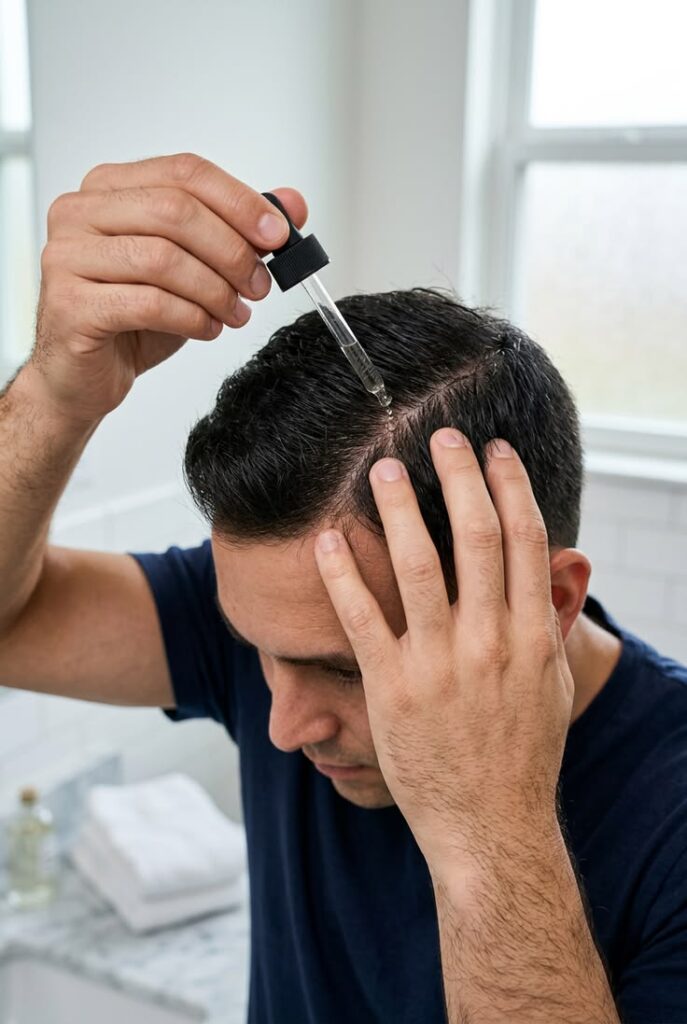
At some point, almost every man on minoxidil asks the same question, even if he never says it out loud: what happens if I just stop? Maybe the daily application has become a hassle. Maybe the cost is adding up. Maybe you are simply curious whether the results you have built up are something you actually own, or something you are renting.
The answer is not complicated, but it is one that surprises a lot of men the first time they hear it clearly: stopping minoxidil does not damage your hair, but it does undo a meaningful amount of the progress you made while using it. Understanding exactly what happens, when, and why takes the mystery out of a decision that a lot of men make without fully knowing what they are choosing.
The Short Answer
Minoxidil does not cure androgenetic alopecia — it manages it for as long as you use it. The hair that minoxidil helped you grow or maintain was being sustained by an active biological process: prolonged growth phases, stimulated follicles, improved blood flow to the scalp. Remove the stimulus, and that process gradually reverses. Hair that was being maintained or regrown begins shedding, typically within a few months, and the scalp slowly returns to the state it would have reached without treatment.
This is not minoxidil causing damage on its way out. It is the absence of the effect that was holding back a process — androgenetic alopecia — that was always going to continue without intervention.
Why Stopping Reverses the Benefits
To understand why this happens, it helps to revisit what minoxidil actually does while you are using it. It is believed to improve blood flow around hair follicles and extend the anagen phase — the active growth period of the hair cycle. Follicles that were producing thinner, weaker hairs due to DHT-driven miniaturization spend more time in active growth, which translates into thicker strands and improved density.
None of this changes the underlying genetics or DHT sensitivity that caused the miniaturization in the first place. Minoxidil works around the problem, not on it. When you stop applying it, the artificial extension of the growth phase ends, and follicles return to the shorter, weaker cycles that DHT was driving before treatment began. The hair that had been growing in that extended window is no longer supported, and it sheds.
The Timeline: What to Expect After Stopping
| Timeframe | What Typically Happens |
|---|---|
| Weeks 1–4 | No visible change in most men; the effects of minoxidil do not disappear instantly |
| Weeks 4–8 | Follicles begin shifting out of the extended growth phase |
| Months 2–4 | Increased shedding becomes noticeable — the hair that was being maintained by treatment |
| Months 4–6 | Density gradually declines toward where it would have been without treatment |
| Months 6–12 | Hair loss typically stabilizes at a level consistent with untreated progression for that point in time |
This timeline is not universal. Men who used minoxidil for a shorter period, or whose results were modest to begin with, may see the reversal happen faster and less dramatically. Men who experienced significant regrowth over years of consistent use often have more to lose — and the shedding phase after stopping can feel correspondingly more noticeable.
Will You Lose Everything You Gained?
In most cases, the hair that was specifically maintained or regrown by minoxidil — meaning hair that would not have existed without treatment — is what gets lost. Hair that was never dependent on minoxidil in the first place, because the follicles producing it were not significantly affected by DHT, is generally unaffected by stopping.
In practice, this means most men return to roughly where their hair loss would have been if they had never started treatment, adjusted for the additional time that has passed and the natural progression of androgenetic alopecia during that period. You do not lose more than you would have lost anyway — you simply lose the benefit that minoxidil was providing while you used it.
Does Minoxidil Make Hair Loss Worse Long-Term If You Stop?
This is one of the most persistent fears around minoxidil, and the evidence does not support it. Minoxidil does not accelerate androgenetic alopecia, damage follicles, or leave hair loss worse off than it would have been without treatment. The “rebound” effect some men describe is not an acceleration of the underlying condition — it is simply the removal of a benefit that was masking the condition’s natural progression.
Put differently: if you had never used minoxidil, your hair loss would have followed its own genetically determined path. Using minoxidil for a period and then stopping returns you to approximately that same path, adjusted for time. It does not put you on a worse path than the one you started on.
Is the “Minoxidil Dependency” Idea Real?
The term “dependency” gets used informally in hair loss communities, and it is worth being precise about what it actually means here, because the word implies something more concerning than the reality.
Minoxidil is not addictive in any pharmacological sense. There is no withdrawal syndrome, no physical dependency, and no chemical need for the body to keep receiving it. What is true is that the benefit is conditional on continued use — similar to how wearing corrective glasses improves your vision only while you are wearing them. Take them off, and your vision returns to what it was without them. That is not dependency in any meaningful sense; it is simply how a maintenance treatment works.
The confusion arises because the loss of benefit feels like a consequence of stopping, when it is really just the natural progression of a condition that was always there, temporarily held back.
Reasons Men Stop — And What Each Means for the Outcome
Stopping Due to Side Effects
Some men stop because of scalp irritation, unwanted facial hair growth from product transfer, or in rare cases more systemic effects from oral minoxidil. In these cases, stopping is often the right call, and the hair loss that follows is the expected trade-off for resolving the side effect. Switching formulations — foam instead of liquid, or a lower concentration — sometimes resolves the issue without requiring full discontinuation.
Stopping Due to Inconvenience
Daily application is a genuine barrier for some men — travel, lifestyle changes, or simply losing the habit over time. This is the most common reason for discontinuation, and it is worth being honest with yourself about whether occasional or inconsistent use is realistic for you before starting, since inconsistent use produces inconsistent results without delivering the benefit of stopping altogether.
Stopping to Switch Treatments
Some men stop minoxidil to transition to a different approach — finasteride alone, a hair transplant, or simply choosing to stop treating hair loss altogether. If transitioning to finasteride, it is worth discussing with a dermatologist whether overlapping the two during the switch makes sense, since finasteride addresses a different mechanism and does not replace the specific follicle-stimulating effect minoxidil was providing.
Can You Restart Minoxidil After Stopping?
Yes. Restarting minoxidil after a period off generally restores the previous benefit over a similar timeline to when you first started — typically three to six months for meaningful improvement, sometimes longer. There is no evidence that minoxidil becomes less effective after a break, though follicles that were already quite dormant before the break may respond more slowly the second time.
That said, repeatedly starting and stopping is not an efficient strategy. Each restart requires going through the adjustment period again, including the possibility of a renewed shedding phase as follicles re-enter the extended growth cycle. Men who find themselves stopping and restarting frequently are often better served by deciding clearly whether to commit long-term or to stop and explore alternative approaches, rather than cycling indefinitely.
A Practical Example
A 34-year-old man has used minoxidil consistently for three years, primarily targeting crown thinning. His density has noticeably improved, and the bald spot that prompted him to start treatment is no longer visible under normal lighting. He decides to stop due to the ongoing cost and the hassle of daily application.
Over the following four to six months, he notices increased shedding, particularly at the crown. By month eight, the area has returned to roughly where it was before he started treatment — not worse, but the improvement is gone. His underlying androgenetic alopecia, which had been held in check by the treatment, has simply resumed its natural progression from where it left off three years earlier, now combined with whatever additional progression would have occurred during those three years regardless.
He is not worse off for having tried minoxidil. He simply no longer has the benefit it was providing — which is exactly what the evidence predicts.
Frequently Asked Questions
How long after stopping minoxidil does hair start falling out?
Most men notice increased shedding beginning around two to four months after stopping, as follicles shift out of the extended growth phase that minoxidil was supporting.
Will my hair loss be worse than if I had never used minoxidil?
No. Stopping minoxidil returns hair loss to approximately the trajectory it would have followed without treatment, adjusted for the time that has passed. It does not accelerate or worsen the underlying condition.
Is minoxidil addictive?
No. Minoxidil has no addictive or physically dependent mechanism. The benefit is simply conditional on continued use, similar to how many maintenance treatments work.
Can I restart minoxidil after stopping for months or years?
Yes. Restarting generally restores the previous benefit over a few months, similar to when you first began. There is no evidence of reduced effectiveness from restarting after a break.
Is it better to taper off minoxidil instead of stopping suddenly?
There is no strong evidence that gradually reducing use produces a meaningfully different outcome than stopping at once. The shedding process is tied to the follicle cycle, not to how abruptly the product is discontinued.
Final Thoughts
Stopping minoxidil does exactly what the biology predicts: the benefit it was providing fades over a few months, and hair loss resumes the path it was always on underneath the treatment. It is not damage, it is not dependency, and it is not a worse outcome than never having started — it is simply the removal of an ongoing intervention from an ongoing condition.
If you are considering stopping, the most useful question is not “will something bad happen” but “am I comfortable losing the specific benefit minoxidil has been giving me.” For some men, the answer is yes — the cost or hassle outweighs the benefit. For others, knowing exactly what they stand to lose is enough to keep going. Either way, the decision is clearer once you know precisely what is at stake.
Written by ModernHairRecovery Editorial Team.