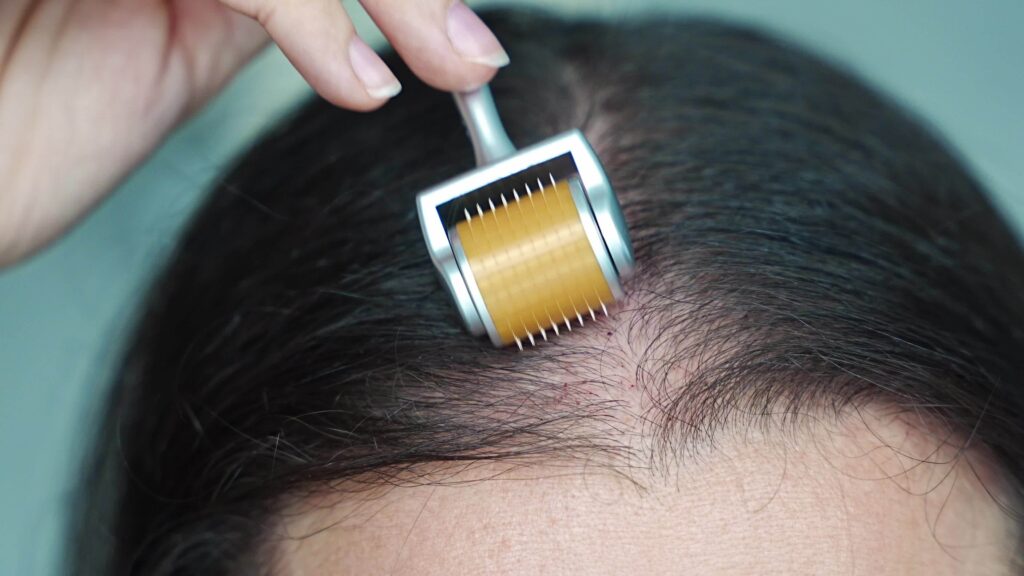
Derma rollers for hair growth are one of the few adjunct treatments where the evidence genuinely justifies the attention they have received. Several randomized controlled trials have found that microneedling combined with minoxidil produces significantly better results than minoxidil alone — and the cost of adding a derma roller to an existing routine is a fraction of what most men spend on a single month of premium supplements with far weaker evidence behind them.
That said, derma rollers are not all the same, and using the wrong needle length, the wrong frequency, or poor hygiene practices can produce scalp irritation or infection rather than hair growth. This guide covers the technical details that actually matter, the honest evidence behind the practice, and specific product recommendations across different needs and budgets.
How Microneedling Actually Works for Hair
A derma roller creates hundreds of controlled micro-punctures in the scalp surface during each session. These tiny injuries trigger a wound-healing response — the release of growth factors including platelet-derived growth factor (PDGF), vascular endothelial growth factor (VEGF), and others that stimulate follicle activity and increase local blood flow.
The second mechanism is equally important for practical use: those micro-channels significantly improve the absorption of topical treatments applied immediately afterward. Studies comparing minoxidil alone to microneedling plus minoxidil consistently find that the combination produces greater hair count improvement — with the most frequently cited trials showing roughly double the hair count increase in the combination group over twelve to twenty-four weeks.
Microneedling does not block DHT. It does not replace finasteride or minoxidil. What it does is amplify the effectiveness of topical treatment already being used — and for men already on minoxidil who want to add something with real evidence behind it, that is a meaningfully different proposition from most of what the supplement market offers.
The Needle Size Question — the Most Important Technical Decision
Needle length is the single most important specification when buying a derma roller for scalp use, and it is where most men make a mistake — either going too short to produce meaningful stimulation, or too long and causing unnecessary trauma, pain, and extended recovery time.
| Needle Length | Effect on Scalp | Appropriate For | Verdict |
|---|---|---|---|
| 0.25mm | Minimal penetration, mainly surface stimulation | Very sensitive scalps, first-time users | Too shallow for meaningful growth factor release in most users |
| 0.5mm | Reaches upper dermis, triggers mild growth factor response | Regular home use, 2–3x per week | Best starting point for most men — effective without excessive recovery |
| 1.0mm | Reaches deeper dermis, stronger growth factor stimulation | Weekly home use only | More effective per session but requires longer spacing — not for frequent use |
| 1.5mm | Deep dermal penetration, significant stimulation | Maximum once weekly, ideally in-clinic | Upper limit for home use; beyond this, professional administration is preferable |
| 2.0mm+ | Subcutaneous penetration, high trauma risk | Clinical settings only | Not appropriate for home use on the scalp |
For most men using a derma roller at home alongside minoxidil, 0.5mm used two to three times per week is the most evidence-aligned starting point. Men comfortable with the practice who want to step up stimulation can consider 1.0mm used once weekly — but should not use 1.0mm at the same frequency as 0.5mm.
How to Use a Derma Roller for Hair Growth
Technique and hygiene matter more than which specific roller you buy. A mediocre roller used correctly will outperform a premium roller used carelessly.
- Clean the roller before every session. Submerge the head in 70% isopropyl alcohol for five to ten minutes before use. This is non-negotiable — introducing bacteria into micro-wounds is the primary infection risk.
- Use on a clean, dry scalp. Washing the hair beforehand removes excess sebum and product buildup that would otherwise be pushed into the micro-channels.
- Roll in multiple directions. Horizontal, vertical, and diagonal passes across the treatment area ensure more even stimulation rather than concentrating trauma along a single line.
- Moderate pressure — not aggressive. You should feel light pressure and mild sensation, not pain. The goal is controlled micro-injury, not deep lacerations.
- Apply minoxidil immediately after. The micro-channels created during rolling significantly increase topical absorption for the following few hours — this is the primary practical benefit for men already using topical treatment.
- Replace the roller head every four to eight weeks. Needles dull with use and a dull needle causes more trauma for less stimulation. This is a consumable, not a permanent device.
Product Reviews: Best Derma Rollers for Scalp Use
Sdara Skincare Derma Roller 0.5mm
Price: Approximately $18–$25 | Needle length: 0.5mm | Needle count: 540 titanium needles
Sdara is consistently the most recommended derma roller for hair growth among dermatologists and hair loss forums alike, and it earns that position not through marketing but through a combination of correct needle length, high needle count, reliable construction, and fair price. The 540-needle head provides dense, even scalp coverage per pass compared to lower-count rollers that create patchier stimulation.
Titanium needles are preferable to stainless steel for repeated use because they maintain sharpness longer — a dull needle is a less effective needle, and titanium extends the useful life of each roller head before replacement. The 0.5mm length is exactly right for the two-to-three-times-weekly protocol most consistent with the evidence from minoxidil combination studies.
Best for: Men starting microneedling alongside minoxidil, or anyone wanting a reliable, correctly specced roller without overpaying.
Verdict: The best overall recommendation in this category. Correct length, high needle count, titanium construction, reasonable price. Buy this unless you have a specific reason to need a different needle length.
DermaRoller by Linduray Skincare 0.5mm
Price: Approximately $20–$28 | Needle length: 0.5mm | Needle count: 540 titanium needles
Very similar specification to the Sdara roller — 540 titanium needles at 0.5mm — with slightly different handle ergonomics that some users prefer for scalp maneuverability. Comes with a case for hygienic storage between sessions, which matters for a device that needs to be kept clean and dry.
The included storage case is a practical advantage over rollers sold without one — storing a derma roller loosely in a drawer allows dust and contamination between sessions, undermining the hygiene protocol that makes the practice safe.
Best for: Men who want equivalent performance to Sdara with a case included and slightly different handle feel.
Verdict: Functionally equivalent to Sdara — the included case is a minor practical advantage, and handle preference is subjective. Both are strong choices at similar price points.
ZGTS Derma Roller 1.0mm
Price: Approximately $15–$22 | Needle length: 1.0mm | Needle count: 540 titanium needles
For men who have used 0.5mm for several months and want to step up stimulation, a 1.0mm roller used once weekly is the evidence-aligned next step. ZGTS produces one of the better-built rollers at this length — consistent needle alignment across the 540-needle head is particularly important at 1.0mm, where uneven needles create uneven penetration depth and inconsistent results.
The critical reminder for 1.0mm: weekly use maximum. Using this at the same frequency as a 0.5mm roller will cause scalp irritation and potentially interfere with normal follicle cycling — the recovery period between sessions matters as much as the session itself at this depth.
Best for: Experienced users who have progressed from 0.5mm and want stronger per-session stimulation at a weekly frequency.
Verdict: Good build quality at a fair price for the 1.0mm step-up. Not a starting point — progress to this from 0.5mm rather than starting here.
Dr. Pen Ultima A6 Electric Microneedling Pen
Price: Approximately $60–$90 | Needle length: Adjustable 0.25mm–2.5mm | Type: Electric microneedling pen
For men who want to move beyond manual derma rollers, electric microneedling pens offer adjustable depth, more consistent needle penetration (no rolling pressure variation), and the ability to target specific areas more precisely than a roller. The Dr. Pen A6 is the most widely used entry-level electric pen for home use and has a large community of hair loss users with documented experience behind it.
The adjustable depth is both the main advantage and the main responsibility: the flexibility to set the wrong depth and cause unnecessary damage is greater than with a fixed-needle roller. Set between 0.5mm and 1.0mm for scalp use, used with the same hygiene and frequency protocol as manual rollers.
Replacement cartridges (the needle heads) cost approximately $1 to $3 each and should be replaced every one to two sessions given the higher per-session intensity compared to a manual roller.
Best for: Men who want more consistent penetration depth and precise targeting than a manual roller, and are comfortable with the additional responsibility of managing adjustable settings.
Verdict: A meaningful step up from manual rollers for men who are committed to the practice and want greater precision. Higher upfront cost but similar ongoing consumable cost once factored per session. Not necessary for most beginners — start with a manual roller and graduate to this if you find the practice genuinely valuable.
Product Comparison
| Product | Needle Length | Type | Price | Best For |
|---|---|---|---|---|
| Sdara Skincare 0.5mm | 0.5mm | Manual roller | ~$18–$25 | Best overall — ideal starting point |
| Linduray 0.5mm | 0.5mm | Manual roller (with case) | ~$20–$28 | Same spec as Sdara, includes case |
| ZGTS 1.0mm | 1.0mm | Manual roller | ~$15–$22 | Step-up for experienced users, weekly only |
| Dr. Pen Ultima A6 | 0.25–2.5mm adjustable | Electric pen | ~$60–$90 | Precision + consistency for committed users |
What Not to Buy
- Rollers with needle counts below 200. Low needle counts create uneven stimulation with larger gaps between penetration points — less effective per session than higher-count alternatives at the same needle length.
- Stainless steel needles for frequent use. Stainless steel dulls faster than titanium — acceptable for single-use or occasional use, but titanium is preferable for a multi-week routine where needle sharpness matters for consistent performance.
- 2.0mm or longer needles for home use. This depth reaches subcutaneous tissue on the scalp and carries meaningful risk of nerve irritation and infection outside a clinical setting with professional technique.
- “Derma stamp” devices marketed specifically as hair growth tools at high prices. Derma stamps (single stamp rather than roller) have a legitimate place in clinical practice but offer no clear advantage over a quality roller for home scalp use, and are often significantly overpriced when marketed specifically for hair loss.
Frequently Asked Questions
What needle size derma roller is best for hair growth?
0.5mm is the best starting point for most men using a derma roller at home two to three times per week alongside minoxidil. It is deep enough to stimulate meaningful growth factor release and improve topical absorption without requiring the longer recovery periods associated with 1.0mm and above.
How often should I use a derma roller on my scalp?
At 0.5mm, two to three times per week is appropriate. At 1.0mm, once weekly maximum. The scalp needs adequate recovery time between sessions — more frequent use at greater depths does not produce better results and can cause irritation that disrupts the follicle environment you are trying to support.
Should I apply minoxidil before or after derma rolling?
After. Apply minoxidil immediately following the session to take advantage of the significantly improved absorption through the micro-channels created by rolling. Applying minoxidil before rolling and then rolling over it pushes product into micro-wounds, which can cause irritation.
How long before derma rolling produces visible results?
Used consistently alongside minoxidil, meaningful improvement in hair count typically becomes visible between months three and six. The growth factor stimulation effect is cumulative — individual sessions produce acute benefit that compounds over consistent use rather than producing immediate visible change.
Can I use a derma roller without minoxidil?
Yes, and some evidence supports standalone microneedling producing hair count improvements. However, the most compelling evidence — and the trials showing the clearest benefit — involves the combination with minoxidil. For men already using minoxidil, adding a derma roller is a straightforward way to amplify existing treatment. Using it without any topical treatment is a reasonable approach but gives up the absorption-enhancement effect that makes the combination particularly valuable.
Bottom Line
A quality 0.5mm derma roller costs $18 to $25 and lasts eight weeks before the head needs replacing — roughly $10 to $12 per month to maintain. For that cost, you are adding a treatment with genuine randomized controlled trial evidence showing measurably better hair outcomes than minoxidil alone, at a fraction of what most supplements charge for evidence that does not come close.
Buy the Sdara 0.5mm, follow the hygiene protocol consistently, apply minoxidil immediately after, replace the head every four to eight weeks, and give it six months. That is the entire strategy — straightforward, evidence-backed, and inexpensive enough that cost is not a meaningful barrier to trying it properly.
Written by ModernHairRecovery Editorial Team.