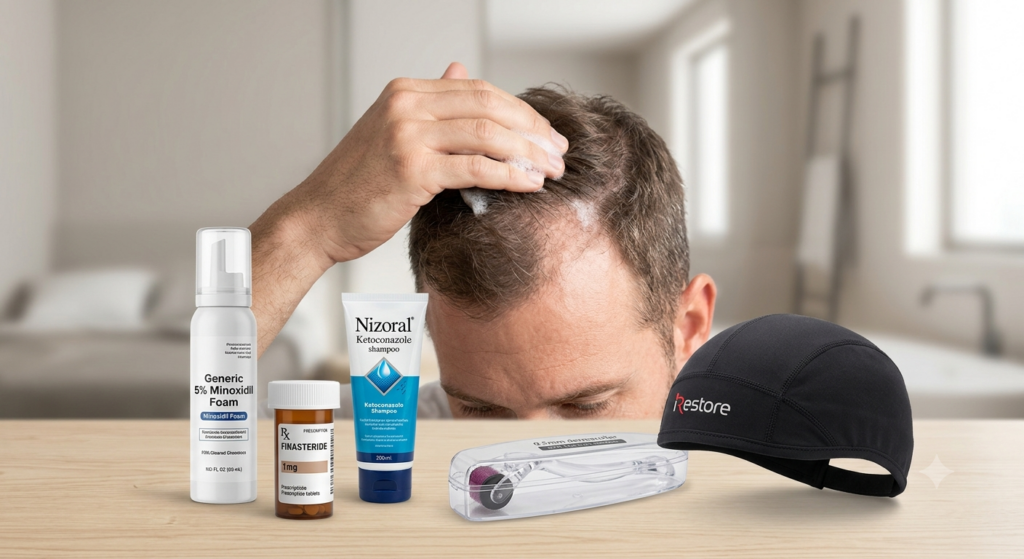
Crown thinning has a specific advantage that most men dealing with hair loss do not fully appreciate until they start researching treatment: of all the areas affected by androgenetic alopecia, the vertex is where the most evidence-backed products produce the most consistent and well-documented results. The original clinical trials for both finasteride and minoxidil used crown thinning as their primary measurement area — which means the products with the strongest data are also the ones with the most relevance to exactly this type of loss.
That is genuinely good news. But knowing which products to buy, in what combination, and at what stage of crown thinning still requires cutting through a market full of products that claim crown-specific benefits without the data to back them up. This guide does that work — organized by evidence strength and by severity, so the recommendation matches where your hair loss actually is right now.
Why the Crown Responds Well to Treatment
Crown follicles in men with androgenetic alopecia tend to be affected somewhat later in the overall progression timeline compared to the hairline and temples, which are typically the first areas where DHT-driven miniaturization becomes visible. By the time crown thinning becomes noticeable, those follicles have had, on average, less cumulative DHT exposure than temple follicles — which typically means more viable follicle tissue to work with at the point of treatment.
This is also why the most frequently cited minoxidil studies show their strongest results at the crown: the follicles there are miniaturizing but often still producing visible, fine hair — the exact stage where treatments that reduce DHT or extend the growth phase have the most to work with. Once follicles go fully dormant, the window for non-surgical intervention narrows significantly regardless of what product is used.
Products Ranked by Evidence for Crown Thinning Specifically
| Product | Evidence for Crown | Mechanism | Rx Required | Monthly Cost |
|---|---|---|---|---|
| Oral finasteride 1mg | Very Strong | Reduces DHT systemically | Yes | $10–$40 |
| Topical minoxidil 5% | Very Strong (crown primary) | Extends growth phase | No | $15–$40 |
| Finasteride + minoxidil combined | Very Strong | Dual mechanism | Partial | $25–$80 |
| Topical finasteride + minoxidil solution | Strong | Local DHT block + growth phase | Yes | $50–$120 |
| Derma roller (0.5mm) + minoxidil | Moderate-Strong | Enhanced absorption + growth factors | No | ~$10–$15/month |
| FDA-cleared laser cap | Moderate | Photobiomodulation | No | $395–$1,100 one-time |
| Ketoconazole shampoo | Moderate (scalp support) | Anti-inflammatory, mild anti-androgenic | No (1%) | $15–$20 |
| Dutasteride 0.5mg | Strong (stronger DHT reduction) | Blocks Type I + II 5-alpha reductase | Yes | $20–$60 |
By Severity: What to Buy at Each Stage
Early Crown Thinning — Diffuse, No Defined Bald Spot
This is the stage with the best prognosis and the widest range of options. Hair at the crown looks less dense than it used to under certain lighting, but no defined area of exposed scalp has emerged yet. Fine hair is still visible across the whole area.
At this stage, the follicles are miniaturizing but still active — this is exactly the window where minoxidil and finasteride produce their most consistent results. Starting treatment here gives both medications the most viable follicles to work with and the longest runway before more aggressive intervention would be needed.
What to buy:
- Generic finasteride 1mg (prescription) — addresses the DHT driving the miniaturization before it progresses further. Generic versions from most pharmacies or telehealth platforms cost $10 to $40 per month.
- Generic minoxidil 5% foam — applied to the crown once or twice daily. Kirkland Signature from Costco or Amazon at roughly $4 to $5 per month is the best value option; foam format is preferred over liquid to minimize scalp irritation.
- Sdara 0.5mm derma roller — used two to three times per week before minoxidil application to improve absorption and add independent growth factor stimulation. Approximately $18 to $25 for the device, $10 to $12 per month in replacement heads.
Optional addition: Nizoral 1% ketoconazole shampoo used two to three times per week to reduce scalp inflammation and optimize the follicle environment.
Moderate Crown Thinning — Defined Thinning Patch, Visible Scalp
A visible area of scalp has emerged at the crown — noticeable in photographs or overhead lighting — but the surrounding transition zone still has active, fine hair. The center may be more advanced than the edges.
Results remain achievable at this stage, though expectations should be calibrated: the center of the patch may show limited regrowth, while the margins — where follicles are more recently affected — often respond better. The combination approach addresses both the cause and the symptom simultaneously.
What to buy:
- Finasteride 1mg + topical minoxidil 5% foam — the full combination, ideally started as soon as possible to preserve the surrounding transition zone before it reaches the dormancy level of the center.
- Derma roller 0.5mm — particularly valuable at this stage for improving minoxidil uptake in the active follicles at the patch margins.
- Nizoral 1% shampoo (2–3x per week) — scalp inflammation is more likely to be a contributing factor in established thinning areas; addressing it directly is worth including.
Consider adding: An FDA-cleared laser cap (iRestore Essential or Theradome EVO LH40) if budget allows and you want to add photobiomodulation alongside the medical and mechanical approaches above.
Advanced Crown Thinning — Large Bald Area, Long-Standing
A significant area of the crown has been smooth and hairless for an extended period — months to years. Few or no visible transitional hairs remain in the central zone.
At this stage, non-surgical products are most valuable for two purposes: preventing further expansion of the bald area into still-active surrounding scalp, and preserving whatever density remains in the transition zone and elsewhere. Meaningful regrowth in the established bald center is unlikely from topical or oral treatment alone — the follicles there have typically been dormant too long to respond.
What to buy for preservation:
- Finasteride 1mg — the most important product at this stage, specifically to halt ongoing progression into still-active areas.
- Topical minoxidil 5% — applied to the transition zone and remaining active areas rather than focusing on the dormant center.
- Nizoral shampoo — ongoing scalp health maintenance.
What to discuss with a specialist: Hair transplant surgery — specifically FUE (follicular unit extraction) — is the most realistic route to cosmetically restoring coverage in a long-established bald crown. DHT-resistant donor follicles transplanted to the vertex maintain their resistance in their new location and produce durable results. Most surgeons recommend continuing finasteride post-transplant to protect non-transplanted areas from ongoing progression.
Specific Product Recommendations
Best Minoxidil for Crown: Kirkland Signature 5% Liquid or Any Generic 5% Foam
Generic minoxidil 5% in any FDA-regulated form delivers the same active ingredient at the same dose as Rogaine. For crown use specifically, foam is often easier to apply accurately to the top of the head without it running. Kirkland liquid from Costco at approximately $4 to $5 per month is the best cost option; any generic 5% foam at $15 to $25 per month is preferable for men with scalp sensitivity to propylene glycol.
Best Finasteride for Crown: Generic 1mg (Telehealth or Pharmacy)
Generic finasteride 1mg from any licensed source — GP prescription, dermatologist, or telehealth platforms like Keeps or Hims — is pharmacologically identical to branded Propecia. For men who want the convenience of a single platform managing both finasteride and minoxidil, Keeps tends to offer the most competitive combined pricing in the US market.
Best Combined Topical Solution: Compounded Finasteride + Minoxidil
Several telehealth platforms and compounding pharmacies now offer finasteride and minoxidil combined in a single topical solution — one application covering both mechanisms. The convenience factor is real, particularly for men who struggle to maintain both an oral tablet and a separate topical routine. Cost ranges from $50 to $120 per month depending on provider and concentration — more expensive than buying separately but competitive with branded prescription products when the consultation cost is factored in.
Best Derma Roller for Crown: Sdara 0.5mm (540 Titanium Needles)
At $18 to $25 with replacement heads at approximately $10 to $12 per month, the Sdara 0.5mm is the most evidence-aligned home microneedling option for combining with minoxidil on the crown. The 540-needle count provides even coverage per pass — important for a curved surface like the top of the head where a low-count roller leaves significant gaps between stimulation points.
Best Laser Cap for Crown: iRestore Essential
At approximately $595 to $695, the iRestore Essential covers the full scalp including the crown comprehensively in each session and has published clinical trial data behind it. For men at moderate to advanced crown thinning who want to add photobiomodulation to their routine without spending $1,000+, it represents the best evidence-to-price balance in the laser cap category.
Routine Templates by Budget
| Budget | Core Products | Estimated Monthly Cost |
|---|---|---|
| Entry-level | Generic minoxidil 5% foam + Nizoral shampoo | ~$20–$30/month |
| Standard | Generic finasteride + generic minoxidil + Nizoral | ~$30–$55/month |
| Optimized | Finasteride + minoxidil + derma roller + Nizoral | ~$40–$70/month |
| Comprehensive | Finasteride + minoxidil + derma roller + Nizoral + laser cap (amortized) | ~$55–$85/month (first year) |
Frequently Asked Questions
What is the best product for crown thinning?
For most men with early to moderate crown thinning, the combination of generic finasteride 1mg and generic minoxidil 5% foam has the strongest clinical evidence and the best evidence-to-cost ratio. The crown is specifically where these products produce their most consistent and documented results.
Does minoxidil work better on the crown than elsewhere?
The strongest and most extensive minoxidil clinical data is specifically from vertex studies — crown thinning is the area where minoxidil has the most documented track record. It tends to produce more consistent results at the crown than at the hairline or temples, though it can help in those areas too.
Can crown baldness be reversed without surgery?
For early to moderate thinning where follicles are still active, non-surgical treatment can produce meaningful improvement and slow or halt progression. For long-established bald areas where follicles have been dormant for years, non-surgical options are more useful for preservation than restoration — surgery is typically required for cosmetic regrowth in those zones.
How long before crown thinning products show results?
Six months is the minimum useful evaluation period. Most men see the clearest picture of whether treatment is working between months nine and twelve. Crown results often become apparent slightly faster than hairline results because follicle viability tends to be higher at the crown at equivalent stages of progression.
Should I use minoxidil foam or liquid for crown thinning?
Foam is generally easier to apply accurately to the crown — it adheres to the scalp better without running when applied to the top of the head, and dries faster. Liquid is cheaper and equally effective when applied correctly; it requires slightly more care to avoid runoff in men with longer hair.
Bottom Line
Crown thinning is the most treatable area on the scalp for men with androgenetic alopecia — a fact that often gets lost in the anxiety of first noticing it. The products with the strongest evidence are also the ones most specifically studied on exactly this area, they are inexpensive relative to what they deliver, and starting them early significantly widens the realistic outcome range.
Generic finasteride and generic minoxidil foam, used consistently and started before significant follicle dormancy sets in, give most men with crown thinning a genuine chance of meaningful improvement rather than just slower loss. Add a derma roller and you have a routine that addresses the issue from three separate angles at a total monthly cost lower than most premium supplement subscriptions — without the weak evidence that typically accompanies those products.
Written by ModernHairRecovery Editorial Team.