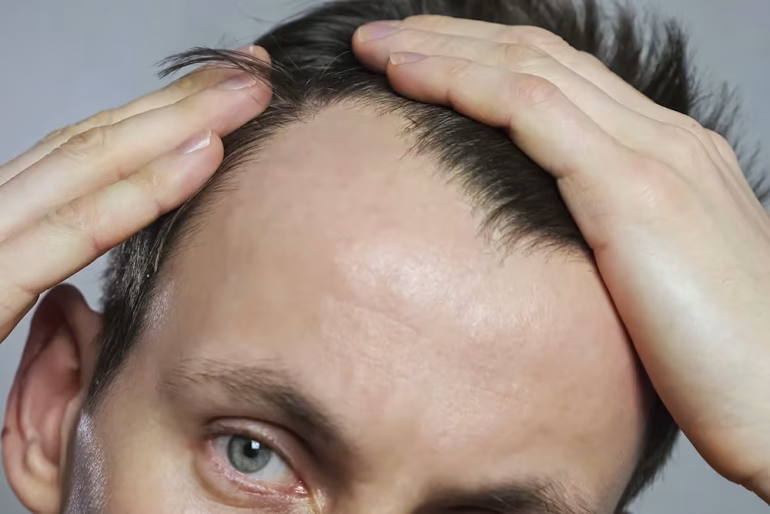
Halting Frontal Hairline Recession
A receding hairline—frequently manifesting as thinning around the temples to form an “M” shape—is one of the earliest indicators of androgenetic alopecia (pattern hair loss). Unlike thinning at the crown or vertex, frontal hairline recession presents distinct biological challenges: hair follicles along the anterior hairline possess higher sensitivity to dihydrotestosterone (DHT) and lower localized microvascular density.
To achieve meaningful regrowth and long-term stabilization, superficial cosmetic shampoos are rarely sufficient. A successful strategy requires a multi-target approach: combining targeted pharmacological interventions, advanced light-based technology, and mechanical stimulation. This guide breaks down the most effective, clinically validated products and modern tech devices available today, outlining how to integrate them into an actionable daily routine.
1. Primary Clinically Proven Topicals & Oral Agents
Topical Minoxidil 5% (Foam vs. Liquid)
Minoxidil remains the FDA-approved gold standard for topical vasodilation. It works by opening ATP-sensitive potassium channels, expanding microvascular blood flow to dormant hair follicles, and extending the anagen (active growth) phase.
- Foam vs. Liquid Solution: The 5% foam formulation is generally preferred for the sensitive frontal hairline. It eliminates propylene glycol, significantly reducing the likelihood of contact dermatitis, severe scaling, and greasy residue.
- Application Best Practice: Apply directly to clean, dry scalp along the receding hairline twice daily. Consistent application for 4 to 6 months is required before assessing visible density changes.
5-Alpha Reductase Inhibitors (Finasteride & Dutasteride)
While minoxidil acts as a growth stimulant, 5-alpha reductase (5-AR) inhibitors target the root hormonal cause of pattern baldness by suppressing the conversion of free testosterone into hair-miniaturizing DHT.
- Oral Finasteride (1 mg daily): Decreases scalp and serum DHT levels by approximately 60–70%, halting progressive regression of sensitive temporal follicles.
- Liposomal Topical Finasteride: A modern alternative designed to deliver localized 5-AR inhibition directly into scalp tissue, significantly reducing systemic circulation while maintaining follicular efficacy.
2. Cutting-Edge Tech & Device-Based Interventions
Low-Level Laser Therapy (LLLT) Caps & Helmets
Low-Level Laser Therapy utilizes medical-grade red laser diodes operating at specific wavelengths (typically 650 nm) to penetrate epidermal tissue. Photons are absorbed by cytochrome c oxidase within mitochondrial cells, increasing adenosine triphosphate (ATP) production and cellular respiration in weakened follicles.
- Laser Diodes vs. LEDs: Choose FDA-cleared devices equipped with true monochromatic laser diodes rather than generic LED lights, ensuring sufficient depth penetration through dense frontal collagen.
- Usage Protocol: Standard clinical protocols recommend wearing the device for 10 to 25 minutes every other day.
Scalp Microneedling (Dermarollers & Motorized Pens)
Microneedling creates controlled micro-injuries in the upper dermis using micro-needles ranging from 0.5 mm to 1.5 mm. This physical process triggers a localized wound-healing cascade, releasing platelet-derived growth factors (PDGF) and epidermal growth factors (EGF).
- Synergy with Topical Treatments: Clinical trials show that pairing weekly 1.0–1.5 mm microneedling with daily 5% minoxidil generates significantly higher hair counts compared to minoxidil monotherapy.
- Safety & Timing: Never apply minoxidil or strong chemical treatments immediately after deep microneedling; allow a 12-to-24-hour window for micro-channels to close.
Practical Case Example: Regimen Integration
Real-World Regimen: Early-Stage Temporal Thinning
User Profile: Alex, 34 – Experiencing mild temporal recession (Norwood Scale 2).
Daily Action Plan:
- Morning: Cleanse scalp; apply 5% Minoxidil Foam to temple points; apply lightweight scalp sunscreen if spending time outdoors.
- Evening: Take 1 mg Finasteride (or apply topical Finasteride/Minoxidil combined serum). Wear an LLLT Laser Helmet for 20 minutes (3 sessions per week).
- Weekly (e.g., Sunday Night): Perform 1.0 mm microneedling passes across receding regions. Skip topical minoxidil until Monday evening to prevent systemic absorption.
3. Targeted Scalp Care & Synergistic Serums
Ketoconazole 1–2% Anti-Inflammatory Shampoo
Although primarily used for anti-dandruff care, Ketoconazole displays mild anti-androgenic activity by disrupting androgen receptor binding on scalp tissue. Using a 1% or 2% formulation 2 to 3 times per week reduces perifollicular inflammation and sebum buildup around fragile hairline follicles.
Peptide Complexes (GHK-Cu & Redensyl)
Biomimetic peptide serums featuring copper tripeptide-1 (GHK-Cu) and polyphenol molecules (such as Redensyl or Capixyl) strengthen the extracellular matrix, anchor hair roots, and reduce oxidative damage along the hair border without hormonal disruption.
Comparison Matrix of Hairline Products & Tech
| Product / Technology | Primary Mechanism | Target Area Focus | Expected Timeframe | Key Benefit |
| 5% Minoxidil Foam | Vasodilation & Anagen prolonging | Frontal Hairline & Crown | 3–6 Months | Proven active growth stimulant |
| Finasteride (Oral/Topical) | 5-AR Inhibition (Reduces DHT) | Entire Scalp | 6–12 Months | Stops progressive follicle shrinking |
| LLLT Laser Cap (650nm) | Mitochondrial ATP stimulation | Diffused Hairline Thinning | 4–6 Months | Non-invasive, drug-free tech |
| Scalp Microneedling | Growth factor induction | Temples & Hairline Margin | 3–6 Months | Multiplies topical absorption |
| Ketoconazole Shampoo | Anti-inflammatory & Anti-fungal | Scalp Surface Environment | 2–3 Months | Clears scalp inflammation & DHT |
Conclusion & Strategic Takeaways
Reversing or maintaining a receding hairline requires consistency and early action, as active hair follicles are far more responsive to treatment than fully fibrosed scalp tissue. A combined approach—blocking local DHT production while physically stimulating growth with minoxidil, microneedling, and photobiomodulation—provides the highest probability of restoring density and preserving your hairline long-term.
Written by ModernHairRecovery Editorial Team.