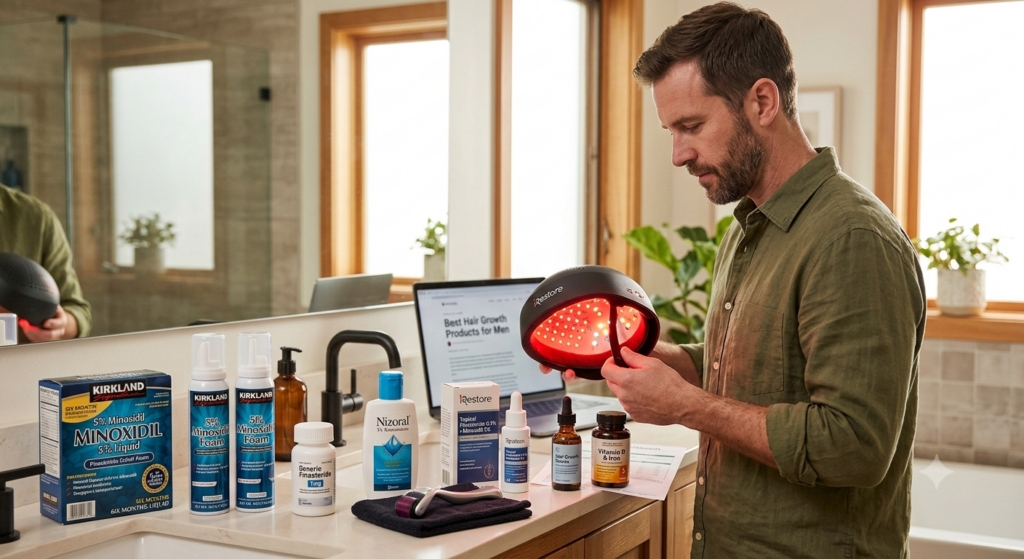
The hair growth product market is one of the most aggressively marketed spaces in men’s health — and one of the most confusing to navigate, because genuinely effective products sit alongside products with almost no clinical backing, often at similar price points and with nearly identical packaging claims.
The filter that actually separates them is simple: what does the clinical evidence show, at what effect size, and for which type of hair loss? Apply that filter consistently and the category becomes much clearer. A handful of products have robust evidence. A larger number have weak or preliminary evidence. Many have none beyond lab studies and testimonials.
This guide walks through every meaningful product category in order of evidence strength, with practical buying guidance and honest assessments of what each can and cannot do.
Understanding What You Are Actually Treating
Before buying anything, knowing the likely cause of your hair loss changes which products are relevant. The most common cause — androgenetic alopecia, or male pattern baldness — is a genetic and hormonal condition driven by DHT progressively miniaturizing susceptible follicles. Products that work for this are almost entirely different from products useful for stress-related shedding, nutritional deficiency hair loss, or scalp inflammation.
If your hair loss follows the typical pattern — temples receding, crown thinning, gradual rather than sudden — androgenetic alopecia is almost certainly involved, and the products below are ranked specifically for that condition. If your loss is sudden, diffuse, patchy, or accompanied by other symptoms, a medical assessment before buying anything is the more useful first step.
The Evidence Hierarchy: Every Major Product Category
| Product Category | Evidence Level | Prescription | Monthly Cost | Best Role |
|---|---|---|---|---|
| Oral finasteride 1mg | Very Strong | Yes | $10–$40 | Primary treatment |
| Topical minoxidil 5% | Very Strong | No | $15–$40 | Primary treatment |
| Finasteride + minoxidil combined | Very Strong | Partial | $25–$80 | Best combined outcome |
| Topical finasteride | Strong | Yes | $30–$100+ | Primary (lower systemic risk) |
| Oral minoxidil (low dose) | Strong | Yes | $10–$40 + consult | Primary (convenience) |
| FDA-cleared laser caps | Moderate | No | $395–$1,100 one-time | Adjunct or drug-free primary |
| Ketoconazole shampoo | Moderate | No (1%) | $15–$20 | Scalp health adjunct |
| Microneedling devices | Moderate | No | $20–$80 one-time | Minoxidil enhancement |
| Hair growth serums (peptides/caffeine) | Weak–Preliminary | No | $30–$80 | Optional cosmetic adjunct |
| Hair growth supplements | Weak (unless deficient) | No | $20–$60 | Deficiency correction only |
Tier 1: Products With Very Strong Evidence
Oral Finasteride 1mg
The most evidence-backed product for male androgenetic alopecia, full stop. Finasteride inhibits 5-alpha reductase, reducing DHT by 60 to 70 percent and directly interrupting the hormonal process causing follicle miniaturization. Decades of long-term study data show the majority of users stabilize or improve over one to two years, with effectiveness maintained in extension studies running a decade or longer.
What to buy: Generic finasteride 1mg — pharmacologically identical to branded Propecia at a fraction of the cost. Available via prescription from a GP, dermatologist, or through telehealth platforms that specialize in hair loss (Keeps, Hims, Manual, Numan depending on region).
What to know: Sexual side effects occur in a minority of users and are typically reversible. PSA levels drop approximately 50 percent on finasteride — inform any doctor running prostate screening. Requires ongoing use; stopping reverses DHT suppression within weeks.
Topical Minoxidil 5%
The most accessible evidence-backed hair growth product available without a prescription. Applied once or twice daily to the scalp, it prolongs the anagen phase and improves follicle environment — working independently of DHT, which makes it highly complementary to finasteride rather than redundant.
What to buy: Generic 5% foam — same active ingredient as Rogaine at significantly lower cost. The foam formulation dries faster and causes less scalp irritation than liquid solution for most men. Expect to spend $15 to $25 per month on generics versus $40 to $70 for branded equivalents that offer no clinical advantage.
What to know: Initial shedding in weeks two to eight is common and temporary. Benefits disappear within months of stopping — factor this into the long-term cost before starting.
Finasteride + Minoxidil Combined
Multiple clinical studies confirm the combination produces greater hair density improvement than either product alone. The two mechanisms are entirely additive — one reducing the hormonal cause, the other stimulating follicle function regardless of hormonal status. For men who are candidates for both, this is the highest-evidence approach available without surgery.
What to buy: Generic oral finasteride 1mg alongside generic topical minoxidil 5% foam covers both mechanisms at the lowest combined cost ($25 to $65 per month). Combined topical solutions containing both in one product are also available through compounding pharmacies and telehealth platforms — convenient but typically more expensive than buying separately.
Tier 2: Products With Strong and Growing Evidence
Topical Finasteride
Delivers finasteride’s DHT-blocking mechanism with significantly lower systemic absorption than the oral tablet — reducing serum DHT by 20 to 40 percent versus oral’s 60 to 70 percent, while maintaining high local DHT suppression at scalp follicles. Available evidence shows comparable hair benefit to oral finasteride in several studies, with lower reported sexual side effect rates correlating with reduced systemic exposure.
What to buy: Available through compounding pharmacies and specialist telehealth platforms, often combined with minoxidil in a single solution. Concentrations of 0.1% to 0.25% are standard. More expensive than generic oral finasteride at $30 to $100+ per month — worth the premium specifically for men who experienced side effects on the oral form or who want lower systemic exposure.
Oral Minoxidil (Low Dose)
Low-dose oral minoxidil (0.25mg to 5mg daily) has rapidly become a widely prescribed off-label alternative for men who find topical application unsustainable. Evidence shows comparable or slightly greater improvement versus topical in some studies, at the cost of a systemic side effect profile — fluid retention, increased body hair, and cardiovascular considerations — that requires prescription and medical supervision.
What to buy: Generic minoxidil tablets are inexpensive ($10 to $40 per month) but require a prescription and initial consultation. Telehealth platforms increasingly offer this alongside finasteride as a combined package. Factor in consultation costs when comparing total monthly spend to topical alternatives.
Tier 3: Useful Adjuncts With Moderate Evidence
FDA-Cleared Laser Caps
Multiple randomized controlled trials show FDA-cleared LLLT devices produce statistically significant hair count improvements versus sham devices. Effect size is real but modest compared to Tier 1 options. Best role: adjunct to medical treatment, or primary drug-free option for men who cannot or will not use prescription therapy.
What to buy: iRestore Essential (~$595), Capillus Pro (~$999), Theradome EVO LH40 (~$395), or HairMax LaserBand 82 (~$595). FDA clearance and true laser diodes (not LED-only) are the non-negotiable criteria. Avoid uncleared devices regardless of diode count claims.
Ketoconazole Shampoo
The most evidence-backed shampoo ingredient for hair loss. Reduces scalp inflammation from Malassezia yeast, improves follicle environment, and has shown measurable improvements in hair shaft diameter in several studies. Used two to three times per week alongside a gentle daily shampoo.
What to buy: Nizoral 1% ketoconazole, approximately $15 to $20. Outstanding value for what it delivers as a scalp health adjunct to medical treatment.
Microneedling Devices
Studies combining microneedling with minoxidil consistently show better outcomes than minoxidil alone. Used as a scalp preparation tool — creating micro-injuries that trigger growth factor release and improve topical absorption — it is a low-cost, low-risk addition to an existing minoxidil routine.
What to buy: A 0.5mm to 1.0mm derma roller with stainless steel needles, replaced every four to eight weeks. Quality options are available for $20 to $50. Use immediately before minoxidil application for maximum absorption benefit.
Tier 4: Limited Evidence — Buy Only for Specific Reasons
Hair Growth Serums
Modern serums often contain peptides (particularly copper peptides), caffeine, melatonin, or botanical extracts with early-stage research behind them. Some have shown promising results in preliminary studies — copper peptides in particular have plausible mechanisms for follicle stimulation — but none have the clinical trial depth of Tier 1 or 2 products. Reasonable as a low-cost addition to an existing routine if the ingredient profile is transparent and evidence-backed; not worth replacing proven treatments for.
Hair Growth Supplements
The most overpromised category in hair loss. Biotin, zinc, vitamin D, iron, and omega-3 supplements are genuinely helpful when addressing confirmed nutritional deficiencies that are contributing to shedding — correcting a real iron deficiency can produce meaningful improvement in hair quality and reduced shedding. Without a confirmed deficiency, the same supplements are unlikely to produce meaningful benefit for androgenetic alopecia.
What to buy — and when: A basic blood panel covering ferritin, vitamin D, zinc, and thyroid function costs less than most hair supplement monthly subscriptions and tells you whether you actually need supplementation. Buy based on results, not based on marketing.
Build Your Routine Based on Your Goal
| Your Goal | Start With | Add Next | Optional Enhancement |
|---|---|---|---|
| Maximum evidence-based results | Generic finasteride + generic minoxidil 5% foam | Nizoral shampoo 2–3x/week | Microneedling device |
| Start without a prescription | Generic minoxidil 5% foam | Add finasteride after consultation | Nizoral + derma roller |
| Minimize systemic side effect risk | Topical finasteride + topical minoxidil | Nizoral shampoo | FDA-cleared laser cap |
| Drug-free only | FDA-cleared laser cap | Nizoral shampoo + microneedling | Saw palmetto 320mg standardized |
| Advanced loss, exploring all options | Hair transplant consultation | Finasteride to protect remaining hair | LLLT as adjunct post-transplant |
| Unexplained shedding, not pattern loss | Blood panel (ferritin, vitamin D, thyroid) | Correct confirmed deficiencies | Dermatologist assessment |
What Not to Buy
A practical list of product types that consistently underperform their marketing claims and should not anchor a hair loss routine:
- Proprietary hair growth supplement blends — multi-ingredient products listing ten or more botanicals at undisclosed or sub-effective doses, priced at $40 to $80 per month for the combined effect of none of them reaching clinical relevance
- Caffeine shampoos as primary treatment — insufficient scalp contact time for meaningful follicle stimulation; useful as a gentle daily shampoo option but not a hair loss treatment
- Any product claiming “guaranteed regrowth” — no pharmacology supports that claim; the presence of this language is a reliable signal that the product is marketing-led rather than evidence-led
- LED-only devices marketed as laser caps — lacking the clinical evidence base of true laser diode devices; particularly problematic when sold without FDA clearance at high price points
- Biotin-enriched shampoos — biotin requires oral ingestion and is not absorbed through the scalp from a rinse-off product in any meaningful quantity
Frequently Asked Questions
What is the single best hair growth product for men?
For men with androgenetic alopecia, the combination of generic finasteride 1mg and generic minoxidil 5% foam has the strongest clinical evidence and the best evidence-to-cost ratio of any approach currently available. If only one product is possible, finasteride addresses the underlying cause more directly than minoxidil for most men with progressive pattern loss.
Are expensive hair growth products better than cheap ones?
Not reliably. Generic finasteride and generic minoxidil are pharmacologically identical to their branded equivalents at a fraction of the cost. Premium pricing in hair loss products more often reflects marketing investment than superior clinical performance.
Can I combine multiple hair growth products safely?
Yes — the most effective routines typically combine products from different tiers targeting different mechanisms. Finasteride plus minoxidil plus ketoconazole shampoo plus microneedling is a commonly used and well-tolerated combination that addresses the hormonal cause, follicle stimulation, scalp health, and topical absorption simultaneously.
Do hair growth supplements actually work?
Only reliably when correcting a confirmed nutritional deficiency. Get a blood panel before buying supplements — it costs less than most hair supplement subscriptions and tells you whether supplementation is actually indicated for your situation.
How long before any hair growth product shows results?
Six months is the minimum evaluation period for any medical hair loss product. Most men see the clearest picture between nine and twelve months of consistent use. Stopping at month three because “nothing is happening” is the single most common reason men conclude treatments do not work when they may simply not have been given enough time.
Written by ModernHairRecovery Editorial Team.