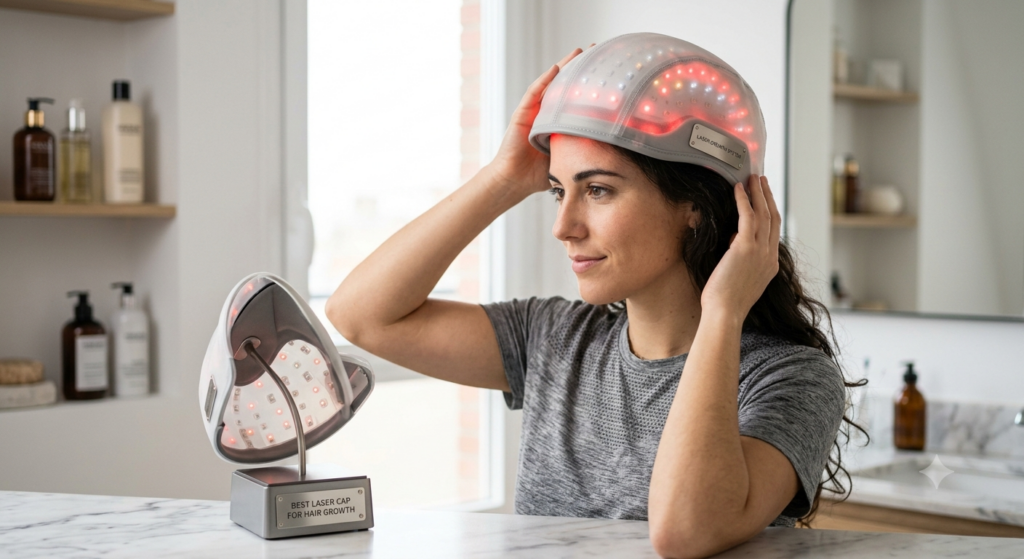
Laser caps occupy an unusual position in the hair loss market — they have genuine FDA clearance and real clinical data behind them, which puts them firmly above the supplement and botanical DHT-blocker category, but their effect size sits well below finasteride and minoxidil. Understanding exactly where they fit, and which specific devices are worth the significant upfront investment, requires cutting through a category that has attracted both legitimate medical device manufacturers and opportunistic marketing.
This guide covers how the technology actually works, what the evidence genuinely shows, the buying criteria that matter, and honest assessments of the leading devices currently available.
How Low-Level Laser Therapy Actually Works
Laser caps use low-level laser therapy (LLLT), also called photobiomodulation — the application of red or near-infrared light at specific wavelengths (typically 630 to 670 nanometers) to biological tissue. At these wavelengths and low power levels, the light does not generate meaningful heat or damage tissue. Instead, it is absorbed by cellular components in the follicle, particularly cytochrome c oxidase in mitochondria, triggering increased ATP production and enhanced cellular metabolism.
The proposed effects on hair follicles include improved scalp blood flow, reduced local inflammation, prolonged anagen phase, and stimulation of follicles in the resting phase back toward active growth. Crucially, LLLT does not affect DHT — it does not interfere with the hormonal mechanism driving androgenetic alopecia, which is why it works as a complement to finasteride and minoxidil rather than as a substitute for either.
What the Evidence Actually Shows
Multiple randomized controlled trials and meta-analyses have found that LLLT devices produce statistically significant improvements in hair count and density compared to sham devices in men with androgenetic alopecia. This is genuine, replicated clinical evidence — not a single study or manufacturer-funded trial.
The consistent findings across this research:
- Meaningful improvement in hair count per square centimeter compared to control groups
- Better outcomes in men with early to moderate hair loss than in those with advanced, long-standing baldness
- Results that require sustained, consistent use — typically three to six months before visible change and six to twelve months for the fuller benefit
- Effect sizes that are real but modest compared to finasteride and minoxidil
The honest summary: LLLT works, within a specific and realistic range of outcomes. It is not a replacement for medical therapy in men with progressive androgenetic alopecia, but as an adjunct or a drug-free primary option for men who cannot or will not use prescription treatments, the evidence supports it.
What to Look for When Buying a Laser Cap
FDA Clearance — Non-Negotiable
FDA clearance for hair loss specifically is the most important filter when evaluating laser caps. This is not the same as FDA approval — clearance means the device has demonstrated substantial equivalence to a previously cleared device in terms of safety and intended use, based on submitted clinical data. It is a meaningful regulatory hurdle that separates legitimate medical devices from uncleared gadgets making identical marketing claims.
Any device without FDA clearance specifically for androgenetic alopecia treatment should be treated with significant skepticism regardless of its diode count or marketing claims.
True Laser Diodes vs LED
This distinction matters more than most buyers realize. True laser diodes produce coherent, collimated light that penetrates scalp tissue to the follicle level at the depth required for photobiomodulation. LEDs produce non-coherent light that scatters more rapidly, with less confirmed penetration depth for follicle stimulation. Most of the strongest clinical evidence for LLLT hair growth has been produced using devices with true laser diodes.
Some manufacturers use a combination of both, or market LED-only devices as “laser” caps. Check the device specifications carefully — the word “laser” in the product name does not guarantee the device contains laser diodes rather than LEDs.
Diode Count and Scalp Coverage
A higher number of laser diodes generally means better coverage across the scalp during each session, which matters particularly for men with thinning across multiple zones rather than a single isolated area. Entry-level devices in the 50 to 80 diode range provide adequate coverage for focused areas; premium devices with 200 to 300+ diodes cover more of the scalp per session.
Session Time and Protocol
Most FDA-cleared devices prescribe sessions of six to thirty minutes, three to four times per week. Devices requiring longer sessions or daily use are not inherently better — the dosing protocols have been developed around specific irradiance levels and session lengths. A shorter session with a higher-density device can deliver equivalent energy to a longer session with fewer diodes.
Device Reviews: What Is Worth Buying
iRestore Essential (FDA-Cleared)
Price: Approximately $595–$695 | Diodes: 51 lasers + 30 LEDs | Session time: 25 minutes, every other day
iRestore has published its own clinical trial showing statistically significant hair count improvements versus sham device over a sixteen-week period, and the product has FDA clearance. The Essential model uses a combination of laser diodes and LEDs — predominantly laser at the follicle-contact points — in a full-helmet design that provides reasonable scalp coverage without requiring the user to reposition the device.
The every-other-day, 25-minute protocol is manageable for most men as a hands-free home routine. The device is bulky compared to cap-style alternatives, which affects portability but does not affect clinical performance during use.
Best for: Men wanting an FDA-cleared device with published clinical evidence at a mid-range price point.
Verdict: One of the stronger value propositions in the category. The clinical data is there, the FDA clearance is genuine, and the price sits below premium alternatives without sacrificing the core evidence basis.
Capillus Pro (FDA-Cleared)
Price: Approximately $999–$1,099 | Diodes: 272 true laser diodes | Session time: 6 minutes daily
Capillus produces cap-style devices (designed to look like a baseball cap) using true laser diodes only — no LED mixing. The Pro model’s 272-diode count provides comprehensive scalp coverage, and the six-minute daily protocol is the most convenient on this list for men who struggle with longer sessions.
The cap form factor is genuinely discreet and wearable during other activities, which meaningfully improves the likelihood of long-term consistent use — the most important variable in LLLT outcomes. Capillus has FDA clearance and a track record in clinical settings.
Best for: Men who prioritize convenience and consistent use over cost, or those who prefer a cap-style device over a helmet.
Verdict: Premium price for premium convenience and diode count. The six-minute protocol is genuinely easier to maintain than 25-minute alternatives, which matters more for long-term outcomes than most buyers initially consider. Worth the premium if routine sustainability is a real concern for you.
Theradome EVO LH40 (FDA-Cleared)
Price: Approximately $395–$495 | Diodes: 40 true laser diodes | Session time: 20 minutes, twice weekly
The most affordable FDA-cleared laser helmet on this list. Theradome uses true laser diodes (no LEDs) at a lower diode count than the premium options, with a twice-weekly protocol that reduces time commitment compared to daily or every-other-day alternatives.
The lower diode count means less scalp coverage per session — adequate for men with localized thinning but less comprehensive for men with diffuse or multi-zone hair loss. The helmet design is well-constructed and the device has maintained FDA clearance since its introduction.
Best for: Budget-conscious buyers who want genuine laser diodes and FDA clearance without the premium price of higher-diode alternatives.
Verdict: Solid entry point into the category. True laser diodes and FDA clearance at the most accessible price point on this list. The lower diode count is the main limitation — manageable for focused thinning, less ideal for broad coverage needs.
HairMax LaserBand 82 (FDA-Cleared)
Price: Approximately $549–$649 | Diodes: 82 laser diodes | Session time: 90 seconds, three times weekly
HairMax is one of the longest-established brands in the LLLT hair loss space, with multiple FDA-cleared devices and published clinical trial data including one of the earliest randomized controlled trials in the category. The LaserBand 82 uses a band-style design that is repositioned across the scalp during the 90-second session — the shortest treatment time of any FDA-cleared device on this list.
The repositioning requirement is the main practical consideration: unlike full-helmet or cap devices, you need to move the band through several positions to cover the scalp, which takes three to five minutes total despite the advertised 90-second active time per position. Still a notably fast protocol compared to 20 to 25-minute helmet sessions.
Best for: Men who want the shortest possible session time with a track record brand and genuine clinical trial history.
Verdict: Strong brand credibility and the fastest effective protocol available. The band design requires more active involvement than set-and-forget helmet options, which some men find more engaging and others find less convenient.
Device Comparison at a Glance
| Device | Price | Diodes | Session Time | Form Factor | Best For |
|---|---|---|---|---|---|
| iRestore Essential | ~$595–$695 | 51 laser + 30 LED | 25 min / every other day | Helmet | Best evidence-to-price balance |
| Capillus Pro | ~$999–$1,099 | 272 laser | 6 min / daily | Cap | Convenience and scalp coverage |
| Theradome EVO LH40 | ~$395–$495 | 40 laser | 20 min / twice weekly | Helmet | Budget entry with true lasers |
| HairMax LaserBand 82 | ~$549–$649 | 82 laser | 90 sec / 3x weekly | Band | Fastest protocol, strong track record |
How Laser Caps Fit Into a Broader Routine
The strongest case for a laser cap is as an adjunct to finasteride and minoxidil rather than as a standalone treatment. Several studies have found that combining LLLT with medical therapy produces better outcomes than either approach alone — which follows logically from the fact that each targets a different part of the problem. Finasteride reduces the DHT driving miniaturization. Minoxidil extends the growth phase. LLLT improves cellular energy and scalp circulation independently of both.
As a standalone treatment for men who cannot or will not use prescription medication, laser caps represent the strongest drug-free option with genuine clinical support — significantly above supplements and botanical DHT blockers in evidence quality, though below prescription options in absolute effect size.
Frequently Asked Questions
Do laser caps actually work for hair growth?
FDA-cleared laser caps have genuine clinical evidence showing statistically significant hair count improvements in men with androgenetic alopecia. Results are modest compared to finasteride and minoxidil but real — particularly for early to moderate hair loss with consistent use over six to twelve months.
Is a laser cap better than minoxidil?
Not on current evidence. Minoxidil has a larger and longer evidence base with generally greater effect sizes. Laser caps offer a drug-free alternative with a different mechanism — they are best understood as complementary to minoxidil rather than superior to it.
How many laser diodes does a cap need to work?
FDA-cleared devices with as few as 40 true laser diodes have shown clinical efficacy in trials. Higher diode counts improve scalp coverage per session, which matters more for men with diffuse thinning across multiple scalp zones than for those with localized loss.
Can I use a laser cap with finasteride and minoxidil?
Yes, and this combination represents the most comprehensive non-surgical approach currently available with evidence support across all three components. The mechanisms are independent and complementary rather than overlapping.
Are cheap laser caps worth buying?
Only if they have genuine FDA clearance and use true laser diodes. Low-cost LED devices marketed as laser caps without FDA clearance are not supported by the same evidence base as cleared devices. The Theradome EVO LH40 at approximately $395 to $495 is the most affordable genuinely evidence-backed option on this list.
Written by ModernHairRecovery Editorial Team.