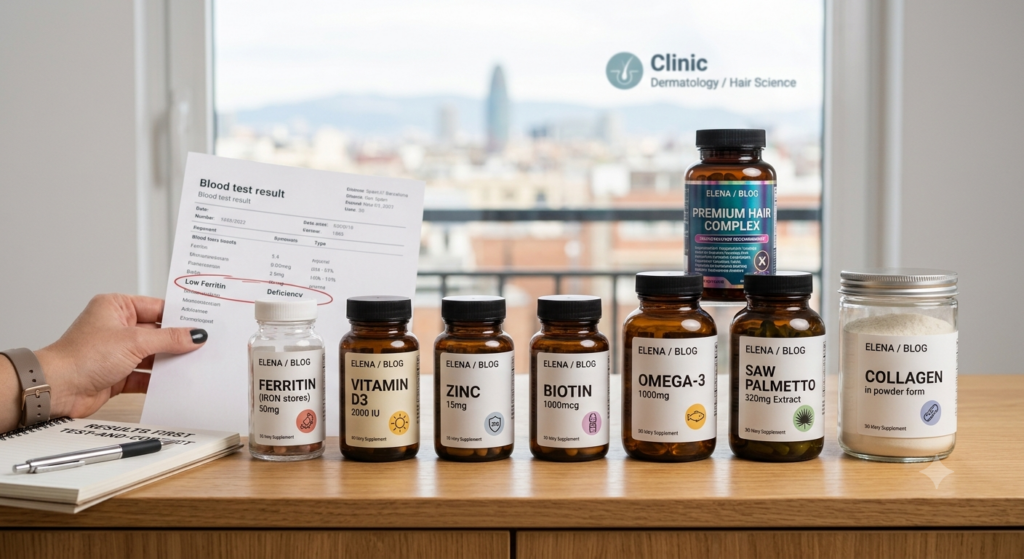
The answer to this question depends almost entirely on why you are losing hair — which is a variable that most supplement marketing deliberately ignores, because the honest answer is inconvenient for sales.
Hair growth supplements can be genuinely useful. They can also be a significant waste of money. The difference between those two outcomes is not about which brand you buy or how many ingredients the formula contains — it is about whether a nutritional deficiency is actually contributing to your hair loss in the first place.
This guide breaks down what each major supplement ingredient can and cannot do, based on what the evidence actually shows rather than what the label claims.
The One Thing That Determines Whether a Supplement Will Help You
Hair follicles have high nutritional demands — they are among the most metabolically active structures in the body and require a consistent supply of amino acids, vitamins, and minerals to sustain active growth. When the body runs short on specific nutrients, hair production is one of the first non-essential functions to be deprioritized. Correcting that shortage restores normal function. This is the legitimate case for hair supplements.
What supplements cannot do is produce hair above and beyond what a nutritionally replete body would already produce. Taking extra biotin when your biotin levels are already normal does not give your follicles more building material — it gives your body excess biotin it does not need, and your hair does not respond to excess the way it responds to sufficiency.
This is why the most useful thing you can do before buying any hair supplement is get a blood panel that checks ferritin, vitamin D, zinc, and thyroid function. That test costs less than most one-month supplement subscriptions and tells you whether you are in the group that will genuinely benefit or the much larger group that will not.
Why Supplements Cannot Stop Male Pattern Baldness
Androgenetic alopecia — the most common cause of hair loss in men — is driven by DHT progressively miniaturizing genetically susceptible hair follicles. This is a hormonal and genetic process. No supplement currently available meaningfully reduces DHT at the level required to interrupt that process — finasteride reduces DHT by 60 to 70 percent; the strongest natural alternatives (saw palmetto, pumpkin seed oil) produce effects that are orders of magnitude weaker and inconsistently replicated.
Men who have pattern baldness and take supplements will generally see no effect on their hairline or crown thinning, because the mechanism driving that loss is not nutritional. They may see improved hair quality in areas not affected by DHT miniaturization — but they will not see the progression slow. That distinction matters significantly when deciding where to spend money.
Ingredient-by-Ingredient: What the Evidence Actually Shows
Biotin
The most aggressively marketed hair supplement ingredient, and the one with the widest gap between marketing claims and clinical evidence. Biotin (vitamin B7) deficiency genuinely causes hair thinning and brittle nails — correcting it produces real improvement. The problem is that true biotin deficiency is uncommon in men who eat a varied diet, and supplementing without deficiency produces no documented hair benefit in healthy individuals.
There is also a clinically relevant practical consideration: high-dose biotin supplementation (common in hair supplement products) interferes with several blood tests, including thyroid panels, cardiac troponin assays, and some hormone tests. If you are taking biotin and planning any blood work, inform your doctor — the interference can produce false results that could affect diagnosis and treatment decisions.
Worth buying if: Confirmed biotin deficiency (rare). Otherwise, pass.
Iron (Ferritin)
Iron deficiency is genuinely one of the more common nutritional causes of hair loss in men, and it is consistently underdiagnosed because standard iron testing often misses it. The relevant marker is serum ferritin (stored iron), not hemoglobin alone — a man can have normal hemoglobin but depleted ferritin stores, and still experience significant diffuse shedding as a result.
When iron deficiency is confirmed and corrected — ideally under medical supervision, since the cause of the deficiency matters as much as correcting it — hair shedding often improves meaningfully over three to six months. This is one of the clearest supplement success stories in hair loss: a specific deficiency with a specific, measurable correction producing a predictable improvement.
The important caution: excessive iron intake is harmful and can cause organ damage over time. Iron supplementation should not be started without a confirmed blood test showing low ferritin, and ideally with a doctor’s guidance on dose and follow-up.
Worth buying if: Ferritin confirmed low on blood test. Do not supplement without testing first.
Vitamin D
Vitamin D receptors are present in hair follicle cells, and multiple studies have found associations between low vitamin D levels and various forms of hair loss, including androgenetic alopecia and alopecia areata. The precise causal mechanism is still being established, but the pattern across independent studies is consistent enough to take seriously.
Vitamin D deficiency is extremely common — particularly in men who spend most of their time indoors or live in northern latitudes — which means this is a deficiency worth checking even without obvious symptoms. Supplementation is straightforward, inexpensive, and low risk, making it one of the more cost-effective tests-and-correct situations in the supplement category.
Worth buying if: Deficiency confirmed on blood test (very common). Inexpensive and low-risk enough to justify testing if you have not already.
Zinc
Zinc plays multiple roles in follicle function — protein synthesis, sebaceous gland regulation, cellular repair during the growth cycle. Zinc deficiency is associated with diffuse shedding and reduced hair quality, and correcting it improves hair health in deficient individuals. Men on restrictive diets, those who eat little red meat or shellfish, or those with conditions affecting absorption are at higher risk of insufficiency.
Supplementing beyond adequate levels does not produce additional benefit and can interfere with copper absorption over time, potentially creating a secondary deficiency. The same test-first logic applies: targeted correction of a confirmed deficiency is useful; supplementing “just in case” is not.
Worth buying if: Confirmed zinc insufficiency on blood test.
Saw Palmetto
The most credible natural option in the DHT-blocking category. Saw palmetto has some preliminary evidence for mild 5-alpha reductase inhibitory activity and modest improvements in hair loss in small studies. One frequently cited comparison found effects approaching low-dose finasteride in a small, short-term study. The evidence is inconsistent and the effect size is much smaller than finasteride — but saw palmetto is genuinely the natural alternative with the most clinical credibility.
Appropriate as a low-risk adjunct for men who cannot or will not use prescription DHT blockers, or as a complement to existing medical treatment. Not appropriate as a replacement for finasteride in men who are candidates for it.
Worth buying if: Avoiding prescription DHT blockers and want the most evidence-backed natural alternative. Standardized extract at 320mg daily from a reputable manufacturer (NOW Foods, Jarrow, Nature’s Way).
Collagen
Collagen supplements provide amino acids that the body uses for various structural proteins, including those in hair. The marketing implication — that taking collagen directly translates to hair growth — significantly overstates what the evidence supports. Ingested collagen is broken down into amino acids during digestion and does not go directly to hair follicles. Whether the specific amino acid profile of collagen supplements provides meaningfully more hair-relevant building blocks than adequate dietary protein intake generally has not been robustly established in men.
Worth buying if: Your overall protein intake is genuinely insufficient. Otherwise, addressing dietary protein directly is more evidence-based and generally cheaper.
Omega-3 Fatty Acids
Omega-3s support scalp health through anti-inflammatory effects and contribute to the integrity of cell membranes in follicle tissue. Some research suggests diets rich in omega-3s are associated with better hair density. The anti-inflammatory effect is the plausible mechanism — reducing scalp inflammation that compounds follicle stress. Not a primary treatment for androgenetic alopecia, but a low-risk general health supplement that may offer marginal benefit at the scalp level.
Worth buying if: Your diet is low in oily fish and you want a general health supplement with some scalp-relevant benefit. Not worth prioritizing over confirmed deficiency corrections.
The Verdict by Ingredient
| Ingredient | Evidence for Hair Loss | Buy It? | Condition |
|---|---|---|---|
| Iron / Ferritin | Strong — for deficiency | Yes | Only if ferritin confirmed low on blood test |
| Vitamin D | Moderate — associated with hair loss | Yes | If deficient — very common, inexpensive to test and correct |
| Zinc | Moderate — for deficiency | Yes | Only if confirmed insufficient; avoid excess |
| Saw palmetto | Weak-moderate — mild DHT effect | Maybe | If avoiding prescription DHT blockers; not a replacement for finasteride |
| Biotin | Only for true deficiency | Rarely | True deficiency is uncommon; interferes with blood tests at high doses |
| Omega-3 | Weak — indirect scalp benefit | Maybe | If diet is low in oily fish; low risk general health supplement |
| Collagen | Very weak — for hair specifically | No | Adequate dietary protein achieves the same goal more cost-effectively |
| Pumpkin seed oil | Very preliminary (one small study) | Maybe | Low risk at $15–$25/month; interesting but far from established |
What About Combination Hair Supplement Products?
The premium-priced hair supplement market is dominated by multi-ingredient blends — products listing ten, fifteen, or twenty ingredients including vitamins, minerals, botanicals, and amino acids, often marketed with names like “Advanced Hair Formula” or “Complete Hair Support Complex.”
The clinical problem with these products is twofold. First, the dose of any individual ingredient is often too low to achieve the level of correction that studies have used when demonstrating efficacy. Second, combining many ingredients at sub-effective doses does not add up to a single effective treatment — it adds up to a product that may technically contain the right ingredients but delivers them at levels unlikely to produce meaningful change.
A man who is iron deficient will get more benefit from a targeted iron supplement at the correct dose than from a blend that contains a token amount of iron alongside fourteen other ingredients at similarly token quantities. Targeted correction of confirmed deficiencies consistently outperforms broad-spectrum supplement blends for hair loss specifically.
The Right Order of Operations
- Step 1: Identify the type of hair loss. Pattern baldness (temples, crown, gradual) points to androgenetic alopecia — supplements will not address this meaningfully as a primary treatment.
- Step 2: Get a blood panel covering ferritin, vitamin D, zinc, and thyroid. This costs less than most monthly supplement subscriptions and tells you what is actually going on.
- Step 3: Correct confirmed deficiencies with targeted, correctly dosed supplementation — ideally with medical guidance, particularly for iron.
- Step 4: If androgenetic alopecia is the primary cause, address it with evidence-based treatment (finasteride, minoxidil, or both) alongside any nutritional corrections.
- Step 5: Consider low-risk adjuncts like saw palmetto or omega-3s if appropriate — but within a realistic understanding of their evidence level.
Frequently Asked Questions
Do hair growth supplements actually work?
Yes, specifically when correcting a nutritional deficiency that is contributing to hair shedding. For men with androgenetic alopecia and normal nutritional levels, supplements are unlikely to produce meaningful hair regrowth regardless of the formula.
Is biotin worth taking for hair growth?
Only if biotin deficiency is confirmed, which is uncommon in men who eat a varied diet. High-dose biotin also interferes with common blood tests, which is worth knowing before taking it alongside any other medical assessment.
Which supplement is most likely to help male hair loss?
Iron (for low ferritin) and vitamin D (for deficiency, which is very common) have the strongest case among nutritional supplements because their link to hair shedding is well-documented and their correction produces measurable improvement. Test first, then supplement based on results.
Can supplements replace finasteride or minoxidil?
No. Supplements do not address the DHT-driven mechanism behind androgenetic alopecia at anything close to the level required to slow it meaningfully. They can support hair health as an adjunct but cannot replace evidence-based medical treatment for pattern baldness.
Are expensive hair supplement blends worth the price?
Rarely. Most premium hair supplement blends contain many ingredients at doses too low to produce the effects those ingredients have shown in studies. Targeted supplementation based on confirmed deficiencies at correct doses is almost always more effective and less expensive than broad-spectrum proprietary blends.
Bottom Line
Hair growth supplements are worth buying in one specific situation: when a blood test confirms a deficiency that is contributing to your hair loss. In that situation, targeted supplementation produces real, measurable improvement at low cost.
In every other situation — particularly for men with androgenetic alopecia and normal nutritional status — the honest answer is that most hair supplements will not change what is happening to your hair. The money spent on premium blends over twelve months is usually better spent on generic finasteride and minoxidil, which address the actual cause of pattern baldness with decades of evidence behind them.
Written by ModernHairRecovery Editorial Team.