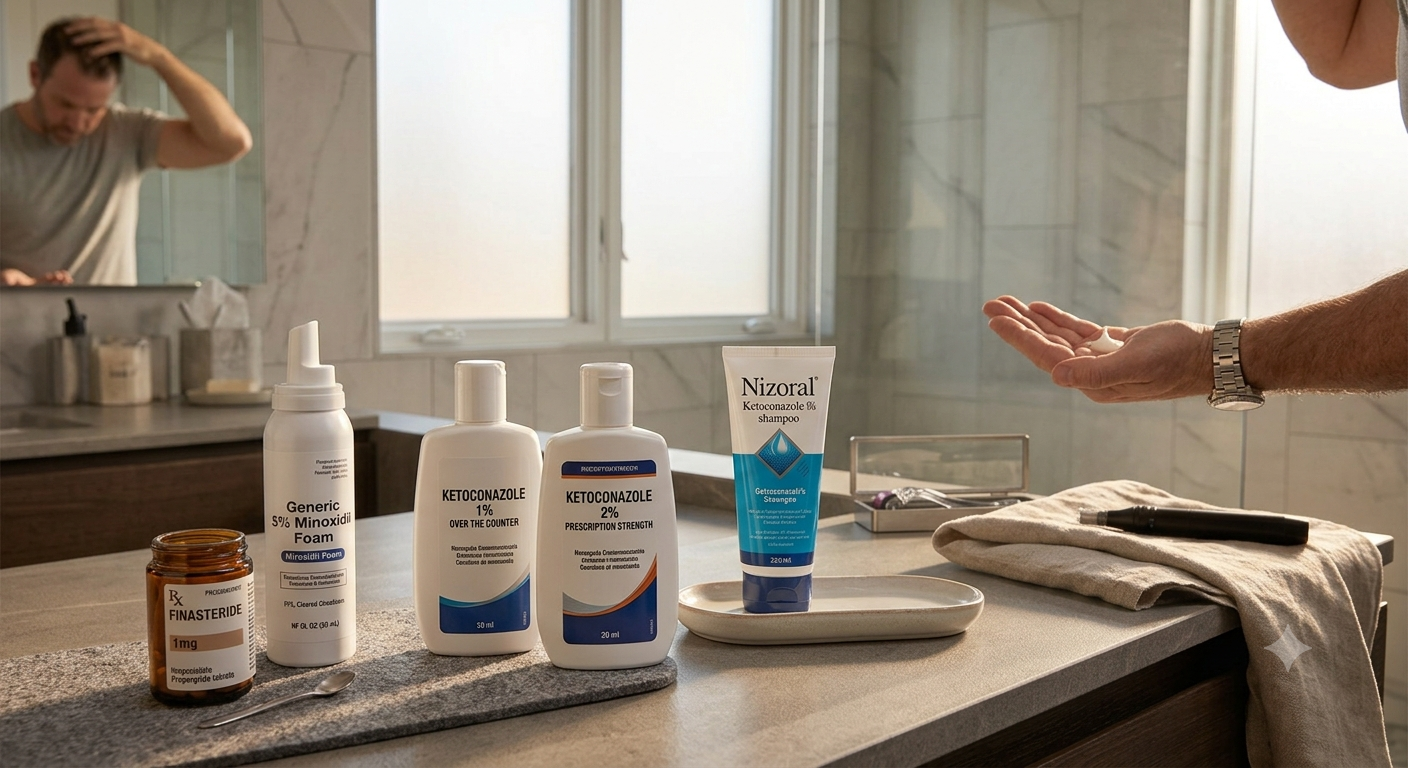
If you’ve researched treatments for male pattern baldness, you’ve probably come across ketoconazole shampoo. Although it’s best known as an anti-dandruff treatment, many dermatologists recommend it as part of a broader hair loss routine.
Unlike Minoxidil or Finasteride, ketoconazole shampoo is not designed to regrow hair on its own. Instead, it may help create a healthier scalp environment, reduce inflammation, and complement other evidence-based treatments.
The challenge is that dozens of shampoos claim to promote hair growth, making it difficult to know which products are actually worth considering. In this guide, we’ll explain what ketoconazole shampoo does, review the characteristics of high-quality formulas, and discuss what current research really says.
What Is Ketoconazole Shampoo?
Ketoconazole is an antifungal medication primarily used to treat dandruff and seborrheic dermatitis.
It works by reducing the growth of Malassezia, a yeast naturally present on the scalp that can contribute to flaking, itching, and inflammation.
Because scalp inflammation may negatively affect hair follicles in some individuals, researchers have investigated whether ketoconazole could also support hair growth as an additional benefit.
Can Ketoconazole Shampoo Help with Hair Loss?
The answer is possibly—but only to a limited extent.
Current research suggests that ketoconazole shampoo may improve scalp health and modestly improve hair density in some men with androgenetic alopecia. However, the evidence is considerably weaker than for Minoxidil or Finasteride, and ketoconazole shampoo is not FDA-approved as a treatment for hair loss. Most experts consider it an adjunct rather than a standalone therapy. :contentReference[oaicite:0]{index=0}
For men with dandruff or seborrheic dermatitis, treating scalp inflammation may also reduce shedding associated with those conditions.
How Does Ketoconazole Work?
Several mechanisms have been proposed:
- Reduces fungal overgrowth on the scalp.
- Helps control dandruff and seborrheic dermatitis.
- May decrease local inflammation around hair follicles.
- May have mild anti-androgenic activity, although this has not been firmly established.
- Supports a healthier scalp environment for existing hair.
Unlike Finasteride, ketoconazole shampoo does not significantly lower systemic dihydrotestosterone (DHT).
What to Look for in a Ketoconazole Shampoo
Ketoconazole Concentration
Most products contain either:
- 1% ketoconazole (commonly available over the counter).
- 2% ketoconazole (prescription in many countries).
The higher concentration is typically reserved for more persistent dandruff or seborrheic dermatitis.
Gentle Cleansing Ingredients
A good shampoo should clean the scalp effectively without excessively drying the hair.
Look for formulas containing moisturizing ingredients to offset the drying effect that medicated shampoos can sometimes cause.
Suitable for Regular Use
Many men alternate ketoconazole shampoo with a gentle daily shampoo to avoid excessive dryness.
Best Types of Ketoconazole Shampoos
1. 1% Ketoconazole Shampoo
Ideal for men with mild dandruff who want to improve scalp health while following a hair loss routine.
2. 2% Ketoconazole Shampoo
Generally recommended when dandruff or seborrheic dermatitis is more severe and prescribed by a healthcare professional.
3. Moisturizing Ketoconazole Formulas
Some shampoos combine ketoconazole with conditioning ingredients to reduce dryness, making them more comfortable for regular use.
Should You Use Ketoconazole Alone?
Probably not.
Most dermatologists view ketoconazole shampoo as part of a comprehensive treatment plan rather than a complete solution.
For men with androgenetic alopecia, stronger evidence supports combining scalp care with treatments such as:
- Topical Minoxidil.
- Oral or topical Finasteride.
- Low-Level Laser Therapy (LLLT).
- Microneedling when appropriate.
How Often Should You Use It?
The ideal frequency depends on the product and your scalp condition.
Many men use ketoconazole shampoo two to three times per week, alternating with a gentle shampoo on other days. Always follow the instructions provided with your specific product or your healthcare provider’s advice.
How Long Before You Notice Results?
Improvements in dandruff and scalp irritation often appear within a few weeks.
Any potential benefit for hair density usually requires much longer.
- Weeks 2–4: Reduced dandruff and itching.
- Months 2–3: Healthier scalp environment.
- Months 4–6: Possible modest improvements in hair appearance when used as part of a broader treatment plan.
Visible hair regrowth should not be expected from ketoconazole shampoo alone.
Cost Considerations
- 1% ketoconazole shampoo: approximately $15–$30 per bottle.
- 2% prescription ketoconazole shampoo: approximately $20–$50, depending on insurance coverage and pharmacy.
- Premium formulations: approximately $30–$60.
Because most users apply the shampoo only a few times each week, one bottle often lasts several months.
Pros and Cons
Pros
- Improves scalp health.
- Effective against dandruff and seborrheic dermatitis.
- Easy to incorporate into an existing routine.
- May provide modest support for hair density.
- Generally well tolerated.
Cons
- Limited evidence as a standalone hair loss treatment.
- Can cause dryness in some users.
- Requires consistent use.
- Does not replace Minoxidil or Finasteride.
Who Should Consider Ketoconazole Shampoo?
Best Candidates
- Men with male pattern baldness and dandruff.
- Individuals with seborrheic dermatitis.
- Those already using Minoxidil or Finasteride.
- Men looking to improve overall scalp health.
May Be Less Suitable For
- Individuals expecting significant hair regrowth from shampoo alone.
- People with very dry or highly sensitive scalps unless advised otherwise by a healthcare professional.
Frequently Asked Questions
Does ketoconazole shampoo regrow hair?
Current evidence suggests it may provide modest benefits for some people, but it should not be considered a primary hair regrowth treatment. It works best as part of a broader treatment strategy. :contentReference[oaicite:1]{index=1}
Is 2% ketoconazole better than 1%?
The 2% formulation is stronger and is commonly prescribed for more persistent scalp conditions. The appropriate choice depends on your individual needs and medical advice.
Can I use ketoconazole shampoo with Minoxidil?
Yes. Many men use both because they target different aspects of scalp health and hair loss.
How many times a week should I use ketoconazole shampoo?
Many products recommend two or three applications per week, although instructions vary between formulations.
Are there any side effects?
Some users experience dryness, mild irritation, or changes in hair texture. These effects are usually temporary and improve by alternating with a gentle moisturizing shampoo.
Final Thoughts
Ketoconazole shampoo is one of the few medicated shampoos with clinical evidence suggesting a potential role in supporting hair health. While it is unlikely to reverse male pattern baldness on its own, it can improve scalp health and may provide modest benefits when combined with proven treatments.
If you have dandruff, seborrheic dermatitis, or scalp inflammation alongside androgenetic alopecia, adding a quality ketoconazole shampoo to your routine may be a practical and relatively inexpensive step. Just remember that the strongest scientific evidence for hair preservation still supports treatments such as Minoxidil and Finasteride, with ketoconazole serving as a complementary option rather than a replacement. :contentReference[oaicite:2]{index=2}