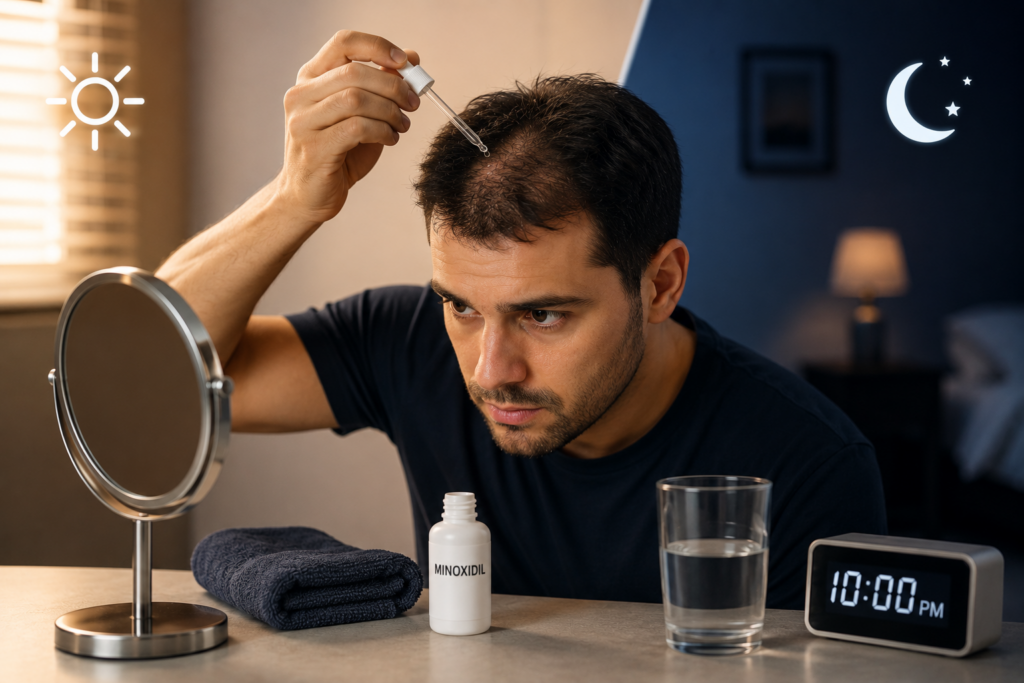
Minoxidil’s instructions seem simple on the label: apply twice daily. But the details that actually determine how much benefit you get from each application — when, how far apart, and under what conditions — are rarely explained well, and getting them wrong is one of the quieter reasons men do not see the results they expected.
None of this changes the underlying biology or speeds up the hair growth cycle. What it does is make sure each application is actually absorbed and doing its job, rather than being undone by water, sweat, sunscreen, or simple bad timing.
The Ideal Daily Schedule
For the standard twice-daily topical solution, the goal is roughly twelve hours of separation between applications, since this keeps a relatively steady level of the active ingredient in contact with the scalp throughout the day and night.
- Morning application: shortly after waking, ideally after showering rather than before, and at least 30 minutes before applying any other scalp or hair product.
- Evening application: roughly 12 hours later, ideally at least 30 minutes to an hour before bed, giving it time to dry fully before your head meets a pillow.
This is a target, not a rule enforced to the minute. A gap of ten to fourteen hours between applications is functionally fine. What matters more is consistency day to day — the same general window, repeated reliably — rather than precision to the exact hour.
Morning: Before or After the Shower?
After. This is one of the more common mistakes, and it matters more than it might seem. Minoxidil needs roughly four hours of contact with the scalp to be properly absorbed. If you apply it and then shower thirty minutes later, you are washing away most of the dose before it has had a chance to work.
The ideal sequence: shower and dry your hair (or let it air dry, towel-dried is fine), then apply minoxidil to a clean, dry scalp. Clean skin without product buildup also absorbs more consistently than scalp covered in the residue of yesterday’s styling products.
Evening: How Long Before Bed?
At least thirty minutes, ideally closer to an hour. Two separate things are happening here that both matter.
First, the same four-hour absorption window applies overnight as it does during the day — going to bed immediately after application does not interrupt this, since you are not washing it off, but lying down on wet hair transfers product onto your pillowcase rather than your scalp, reducing the effective dose you actually absorb.
Second, a damp pillowcase is uncomfortable and, over time, can lead to product buildup on bedding that then transfers back onto your face and skin, which is a common cause of unrelated skin irritation that gets mistakenly blamed on the minoxidil itself rather than on pillowcase residue.
What Breaks the Absorption Window
The four-hour rule is the single most important timing detail, and several common daily habits interfere with it without most men realizing why their results seem inconsistent.
- Swimming. Pool or ocean swimming within the absorption window washes away a meaningful portion of the dose. If you swim regularly, apply after rather than before, even if that means shifting your usual schedule slightly that day.
- Heavy sweating from exercise. Intense workouts that cause significant scalp sweating within a few hours of application can reduce effectiveness. Many men solve this by applying after their workout rather than before.
- Rain or unexpected water exposure. Not something you can always control, but worth knowing — if your scalp gets soaked within the absorption window, that application’s effectiveness is likely reduced, though this occasionally happening is not something to be anxious about.
- Applying other scalp products too soon afterward. Styling products, sunscreen sprays that reach the scalp, or other topical treatments applied within the same window can interfere with absorption or dilute the minoxidil before it has set.
Does It Matter If You Apply at Different Times Each Day?
Some inconsistency in exact timing is not going to undermine months of treatment. What causes a more meaningful problem is irregularity that becomes a pattern — frequently skipping the evening dose, or letting the gap between applications shrink to just a few hours on busy days, effectively turning twice-daily use into something closer to once-daily without realizing it.
If your schedule genuinely varies day to day — shift work, travel, irregular hours — the more useful goal is maintaining roughly two applications spaced at least eight hours apart, rather than rigidly trying to hit the same clock time every single day. Flexibility around the principle matters more than precision around the clock.
Foam vs Liquid: Does Timing Change?
The core timing principles are the same for both formulations, but there are minor practical differences worth knowing.
Foam tends to dry slightly faster than liquid solution, which can make the evening application marginally more convenient if you are trying to minimize the wait before bed. Liquid solution often contains propylene glycol, which can take longer to fully dry and is also the more common cause of scalp irritation for sensitive users — worth knowing if you experience irritation and have not yet tried switching formulations.
If You Only Apply Once a Day
The standard 5% topical solution is studied and labeled for twice-daily use, and that remains the evidence-backed standard for most formulations. That said, some newer foam products are specifically formulated and labeled for once-daily application, with research supporting comparable effectiveness to the twice-daily liquid — but this depends on the specific product, and switching to a once-daily regimen with a product not designed for it is not a reliable substitute.
If twice-daily use is genuinely unsustainable for your routine, a once-daily product specifically formulated for that use is a better solution than applying a twice-daily product only once and hoping for similar results — the formulations are not interchangeable in terms of concentration and delivery despite looking similar on the shelf.
A Sample Daily Routine
For most men with a fairly standard schedule, a routine that works reliably looks something like this:
- Wake up, shower as usual
- Towel-dry hair, then apply minoxidil to a dry scalp before getting dressed
- Let it air-dry for the remaining time it takes to get ready — usually sufficient
- Go about the day; avoid swimming or intense exercise in the hour immediately after if your schedule allows flexibility
- In the evening, roughly 12 hours later, apply again at least 30–60 minutes before getting into bed
- Let it dry fully before lying down
This is a template, not a strict requirement — the underlying principles (apply to clean dry scalp, allow adequate drying time, maintain roughly 12-hour spacing) are what matter, and they can be adapted to fit shift work, travel, or any other schedule that does not match a standard nine-to-five day.
Frequently Asked Questions
Is morning or night better for applying minoxidil?
Neither is inherently superior — what matters is consistent spacing of roughly twelve hours between the two daily applications, and ensuring each one has adequate time to dry and absorb without being washed away or disturbed.
How long should I wait after applying minoxidil before showering?
At least four hours for full absorption. This is why applying after your morning shower, rather than before, is generally the more practical approach for most daily routines.
Can I apply minoxidil right before bed?
It is better to apply at least thirty minutes to an hour before lying down, allowing the product to dry. Going to bed with a wet scalp transfers product onto your pillow rather than letting it absorb fully.
Does sweating from exercise reduce minoxidil’s effectiveness?
Heavy sweating shortly after application can reduce how much is absorbed. Applying after a workout, rather than before, avoids this issue for men with a regular exercise routine.
What happens if I accidentally apply too close to my last dose?
Applying earlier than planned occasionally is not harmful, though it shortens the spacing between doses and is not something to make a regular habit. An occasional irregularity is far less impactful than a consistent pattern of inadequate spacing or skipped applications.
Final Thoughts
The best time to apply minoxidil is not a single magic hour — it is a consistent routine built around two applications spaced roughly twelve hours apart, each given at least four hours of uninterrupted contact with a clean, dry scalp before water, sweat, or other products get in the way. Get those basics right and the exact clock time matters very little.
Most of what determines whether minoxidil works is patience and months of consistent use. But within that larger picture, small timing habits — applying after the shower instead of before, waiting before bed, avoiding a swim right after dosing — are the kind of detail that quietly separates men who get the full benefit of the product from men who are technically using it correctly on the label, but losing a meaningful portion of each dose to avoidable timing mistakes.