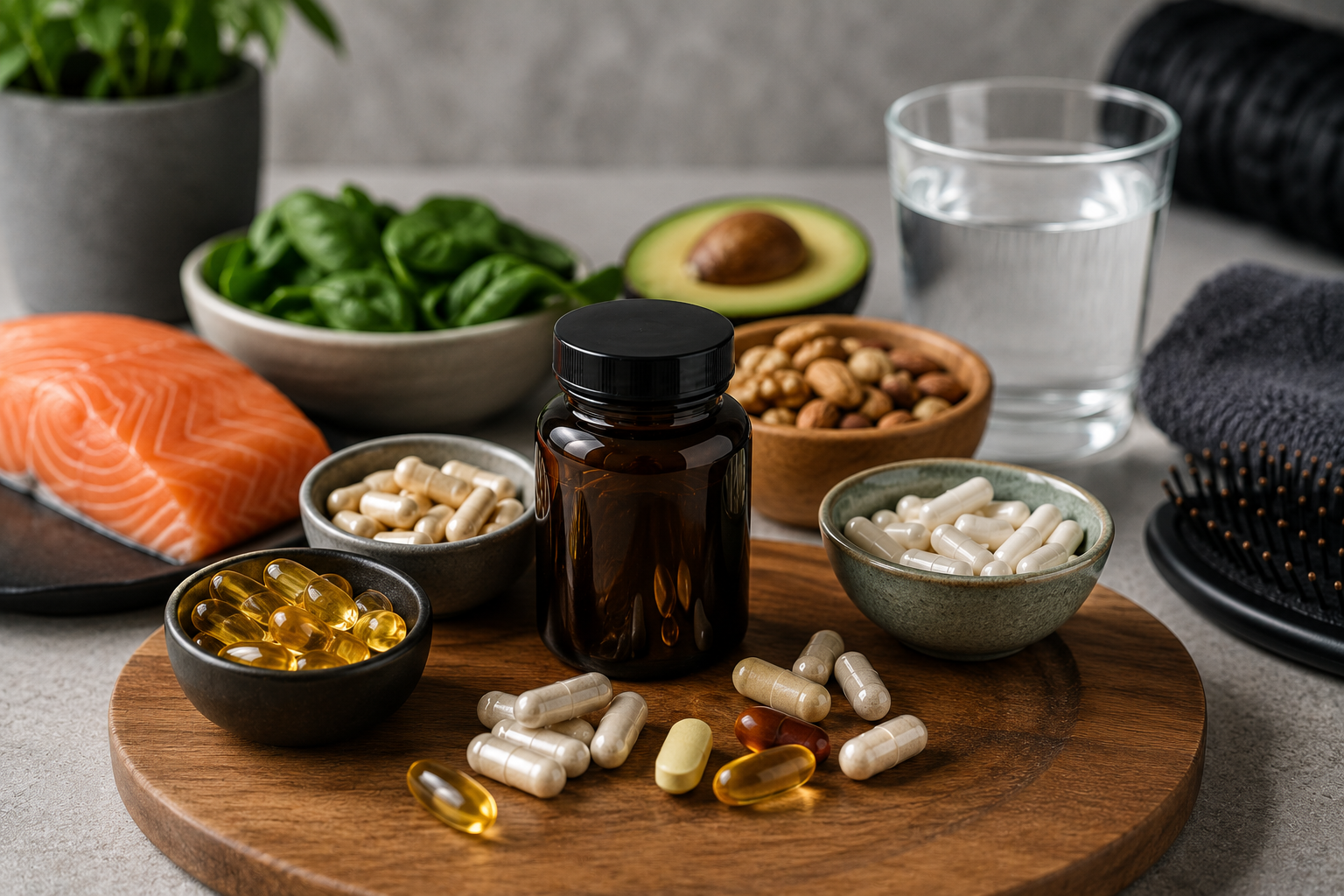
Walk into any pharmacy or scroll through social media, and you will encounter dozens of daily supplements claiming to restore thinning hair overnight. Brightly colored gummies, multi-ingredient «hair formulas,» and high-dose biotin pills promise dramatic transformations. Yet, behind the aggressive marketing, the clinical reality is far more nuanced.
Hair follicles are among the most metabolically active structures in the human body. When your system lacks essential nutrients, non-essential processes—like hair production—are often the first to suffer. However, taking mega-doses of random vitamins will not magically stop genetic hair loss or regrow a receding hairline if a nutritional deficiency is not the root cause.
This guide cuts through the marketing noise to analyze which vitamins genuinely support male hair health, how to identify whether you actually need them, and how to build an effective, evidence-based strategy.
1. How Nutritional Status Impacts Male Hair Growth
To understand how vitamins affect hair, it helps to understand the hair growth cycle. Each follicle goes through three main phases:
- Anagen (Growth Phase): Active hair production lasting two to six years.
- Catagen (Transition Phase): A brief two- to three-week period where growth stops.
- Telogen (Resting Phase): A two- to four-month phase ending with shedding, allowing a new hair to begin growing.
When your body experiences a shortage of critical vitamins or minerals, more hair follicles get pushed prematurely into the telogen phase—a condition known as Telogen Effluvium. This results in diffuse, widespread thinning across the entire scalp rather than the structured, pattern-based recession seen in male pattern baldness (Androgenetic Alopecia).
Key Takeaway: Vitamins primarily support the structural integrity of the follicle and keep hair in the active growth phase. They do not block DHT (dihydrotestosterone), the primary hormone responsible for genetic male pattern baldness.
2. Essential Vitamins and Minerals for Hair Health
While many supplements include long lists of ingredients, only a few vitamins have established links to hair follicle function.
Vitamin D3
Vitamin D acts more like a hormone than a typical vitamin in the body. It plays a direct role in creating new hair follicles and awakening dormant ones.
- The Link: Clinical research shows a strong correlation between low serum Vitamin D levels and increased hair shedding, as well as conditions like alopecia areata.
- Optimal Source: Sunlight exposure, fatty fish (salmon, mackerel), fortified foods, or a daily D3 supplement (typically 1,000–4,000 IU depending on blood levels).
Iron and Ferritin
Iron is critical for producing hemoglobin, which delivers oxygen and nutrients directly to the hair matrix cells.
- The Link: Ferritin represents stored iron in your tissues. Even if your red blood cell count appears normal on a routine lab test, low ferritin levels can trigger significant hair shedding in men.
- Optimal Source: Red meat, lentils, spinach, and pumpkin seeds. (Note: Only supplement iron if a blood test confirms low ferritin, as excess iron can be toxic).
Vitamin B12 and Folate (B9)
Both nutrients are essential for red blood cell production and cellular division—two vital processes for maintaining the high metabolic turnover in active hair follicles.
- The Link: Deficiencies impair oxygen supply to the scalp tissue, leading to weakened hair shafts and slower overall growth rates.
- Optimal Source: Eggs, meat, dairy products, and leafy greens. Plant-based eaters often require B12 supplementation.
Zinc
Zinc is a fundamental trace mineral involved in cellular repair, tissue growth, and oil gland function around the hair follicle.
- The Link: Zinc deficiency is well-documented as a cause of brittle hair and accelerated shedding. However, over-supplementing zinc can disrupt copper absorption, paradoxically worsening hair quality.
- Optimal Source: Oysters, beef, pumpkin seeds, and chickpeas. Standard daily dosages in balanced supplements range from 11mg to 15mg.
3. The Biotin Myth: What Men Need to Know
Biotin (Vitamin B7) is marketed heavily as the ultimate hair growth solution. However, true biotin deficiency in men who eat a standard diet is exceedingly rare.
- What Science Says: Biotin supplementation significantly improves hair growth only in individuals who have a diagnosed biotin deficiency or an underlying genetic condition affecting B7 metabolism.
- The Risk: High-dose biotin supplements (often containing 5,000 mcg to 10,000 mcg) can interfere with important lab tests, including thyroid panels and troponin tests used to detect heart attacks.
| Feature | Marketing Claims | Clinical Evidence |
| Primary Scope | «Regrows hair for all men» | Only resolves shedding caused by a true B7 deficiency |
| Effectiveness | «Thickens hair overnight» | No impact on male pattern baldness or DHT-related loss |
| Dosage View | «More is always better» | Excess doses distort critical medical blood work |
4. How to Determine If You Need Hair Supplements
Instead of purchasing expensive multi-vitamin blends immediately, follow this systematic evaluation process:
Step 1: Identify Your Shedding Pattern
- Diffuse, overall thinning: High likelihood of nutritional or stress factors.
- Receding hairline / crown thinning: High likelihood of genetic loss driven by DHT. (Internal Link Suggestion: Read our guide on medical solutions like topical minoxidil and finasteride).
Step 2: Request a Targeted Blood Panel
Ask your primary doctor or dermatologist to check:
- Serum Vitamin D (25-hydroxy)
- Ferritin (Iron stores)
- Vitamin B12 & Folate
- Thyroid function (TSH)
Step 3: Target the Gap
- Supplement ONLY what shows low on lab results.
- Focus dietary improvements on foundational whole foods.
Practical Examples
- Scenario A (Nutritional Deficit): Mark notices sudden, widespread hair shedding three months after changing to a restrictive diet. His blood panel reveals a ferritin level of 18 ng/mL (low). Correcting his iron levels under medical supervision resolves the shedding over the next six months.
- Scenario B (Genetic Hair Loss): Alex notices his hairline slowly receding at the temples over two years. His blood panel is completely normal. Taking a biotin supplement yields no change because his hair loss is driven by sensitivity to DHT, requiring medical treatments or photobiomodulation (Internal Link Suggestion: See our review on laser caps for hair growth) rather than nutritional correction.
5. Building an Effective Hair Health Strategy
To maximize results without wasting money, prioritize your efforts using this framework:
- Level 1: Establish a Whole-Food Baseline: Ensure your diet contains adequate protein (hair is made of keratin, a protein), healthy fats, and dark leafy vegetables.
- Level 2: Get Tested Before You Invest: A basic blood panel typically costs less than a two-month supply of premium hair gummies and provides actionable data.
- Level 3: Combine Nutrition with Proven Therapies: If you are dealing with male pattern baldness, view nutritional optimization as a supporting layer rather than a standalone fix. Pair a balanced diet with clinically proven FDA-approved treatments for optimal results.
Frequently Asked Questions
Can vitamins regrow a hairline lost to male pattern baldness?
No. Male pattern baldness is driven by a genetic sensitivity to dihydrotestosterone (DHT), which causes hair follicles to shrink over time. Vitamins support general follicle health but cannot block DHT or revive completely inactive follicles.
How long does it take for vitamins to improve hair quality?
Because the hair growth cycle is slow, it typically takes three to six months of consistent supplementation to notice a reduction in shedding or an improvement in shaft quality after correcting a true deficiency.
Are hair growth gummies as effective as pill supplements?
Gummies often contain lower doses of active ingredients, added sugars, and fewer stable forms of key minerals compared to standard capsules or tablets. Standard, unflavored supplements or targeted single-ingredient capsules usually provide better value and purity.