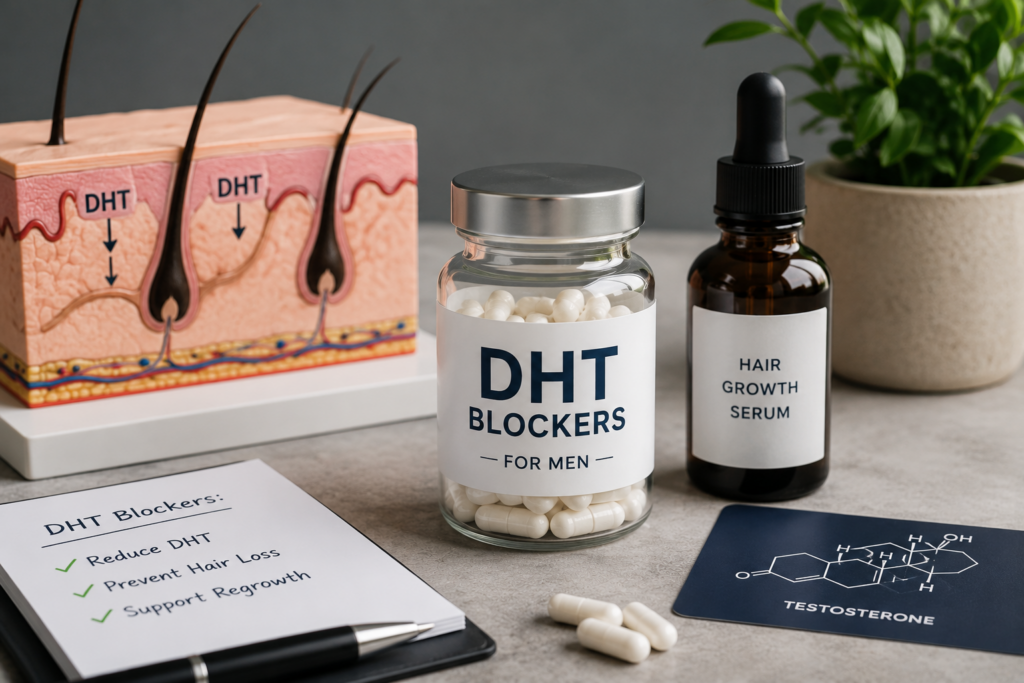
DHT blockers are one of the most searched categories in men’s hair loss — and also one of the most confusing to navigate, because the term gets applied equally to a prescription medication with decades of clinical trial data and a herbal supplement with a handful of preliminary studies. They are not in the same category, and treating them as if they were leads men to either overpay for products that underdeliver or avoid the most effective option because they do not fully understand what it does.
This guide ranks every meaningful DHT-blocking option by actual evidence strength, with honest buying guidance for each. No inflated claims for natural alternatives, no dismissal of the real role they can play as adjuncts. Just an accurate hierarchy so you can make a decision based on what the data actually supports.
What DHT Blocking Actually Means
DHT (dihydrotestosterone) is produced when the enzyme 5-alpha reductase converts testosterone. In men genetically predisposed to androgenetic alopecia, DHT binds to receptors in scalp hair follicles and progressively shrinks them — a process called miniaturization that eventually stops visible hair production altogether.
A DHT blocker, in the strictest sense, is anything that reduces the amount of DHT available to bind to those receptors — either by inhibiting 5-alpha reductase (stopping production) or by interfering with DHT binding itself. The degree to which any given product achieves this, and at what level of evidence, is what separates the products on this list from each other more than anything else.
DHT Blockers Ranked by Evidence
| Product / Ingredient | Evidence Level | DHT Reduction | Prescription | Approx. Monthly Cost |
|---|---|---|---|---|
| Finasteride 1mg (oral) | Very Strong | 60–70% systemic | Yes | $10–$40 |
| Topical finasteride | Strong — growing | 20–40% systemic, high local | Yes | $30–$100+ |
| Dutasteride (oral) | Strong | 90%+ systemic | Yes | $20–$60 |
| Saw palmetto (oral supplement) | Weak — preliminary | Mild, inconsistent | No | $10–$30 |
| Pumpkin seed oil (oral) | Very weak | Speculative | No | $15–$40 |
| Ketoconazole shampoo | Moderate (scalp only) | Local, mild | No (1%) / Yes (2%) | $10–$20 |
| DHT-blocking shampoos (botanical) | Very weak | Negligible in rinse-off | No | $15–$50 |
#1 — Finasteride 1mg: The Gold Standard
No product on this list comes close to finasteride in terms of clinical evidence, proven DHT reduction, or documented long-term effectiveness for androgenetic alopecia. It inhibits Type II 5-alpha reductase — the primary isoform active in scalp follicles — reducing serum DHT by 60 to 70 percent at the standard 1mg daily dose.
Decades of study data consistently show that the majority of men who take it either stabilize their hair loss or achieve measurable regrowth over one to two years, with effectiveness maintained in long-term extension studies spanning a decade or more. Generic finasteride is also one of the best value purchases in hair loss treatment — pharmacologically identical to branded Propecia at a fraction of the cost.
What to buy: Generic finasteride 1mg from any licensed pharmacy with a prescription. Telehealth platforms (Keeps, Hims, Manual, Numan depending on your region) can prescribe and ship directly if an in-person appointment is inconvenient. Branded Propecia offers no clinical advantage over generic versions.
What to know before buying: Sexual side effects occur in a minority of users and are typically reversible on stopping. PSA levels are reduced approximately 50 percent on finasteride — inform any doctor doing prostate screening. Requires ongoing use; stopping reverses the DHT reduction within weeks.
#2 — Topical Finasteride: Lower Systemic Exposure
Topical finasteride applies the same active compound directly to the scalp, achieving high local DHT suppression while significantly reducing how much enters systemic circulation — typically 20 to 40 percent serum DHT reduction compared to oral’s 60 to 70 percent. This lower systemic profile correlates with fewer reported sexual side effects in available studies.
The evidence base is growing rapidly and several comparative studies have found topical finasteride produces hair benefit comparable to the oral form for many men. It now represents a well-supported, not experimental, alternative for men who want finasteride’s mechanism with reduced systemic exposure.
What to buy: Available through compounding pharmacies and specialist telehealth hair loss platforms, often combined with minoxidil in a single solution. Concentrations of 0.1% to 0.25% are most commonly prescribed. More expensive than oral generic — factor in $30 to $100+ per month depending on formulation and provider.
#3 — Dutasteride: The More Potent Option
Dutasteride inhibits both Type I and Type II 5-alpha reductase isoforms, compared to finasteride which primarily targets Type II. This broader inhibition results in DHT reduction of 90 percent or more — meaningfully greater than finasteride’s 60 to 70 percent. Several studies comparing the two directly have found dutasteride produces greater hair count improvement, particularly at the crown.
The trade-off is a more comprehensive hormonal effect, which some men and prescribers consider appropriate caution given that Type I reductase has roles in tissues beyond the scalp. Dutasteride is approved for hair loss in some countries (Japan, South Korea) and prescribed off-label for this purpose in others where it is only approved for BPH (benign prostatic hyperplasia).
What to buy: Generic dutasteride 0.5mg — typically prescribed as daily or alternate-day dosing for hair loss. More expensive than generic finasteride but still relatively affordable at $20 to $60 per month. Requires prescription and is best approached after discussing the expanded side effect profile with a prescribing doctor, particularly if you are already a finasteride non-responder.
Best suited for: Men who have not responded adequately to finasteride after a genuine trial, or those whose prescribing doctor recommends it based on their specific clinical picture.
#4 — Saw Palmetto: The Most Credible Natural Option
Saw palmetto extract has more preliminary evidence behind it than most natural DHT-blocking supplements, and it is reasonable to describe it as the most credible option in its category — which is not the same as saying it is equivalent to finasteride, because it is not.
Some studies have found saw palmetto produces modest improvements in hair density and reduced hair loss with consistent oral use, with one frequently cited comparison suggesting effects approaching low-dose finasteride in a small study population. The evidence base is inconsistent, the effect size is much smaller than prescription options, and the mechanistic evidence for 5-alpha reductase inhibition is primarily from lab studies rather than robust human trials.
Where saw palmetto has a legitimate place is as a low-risk, no-prescription adjunct for men who are not candidates for finasteride, or as a complement to prescription treatment for men who want to add a natural element to their routine.
What to buy: Standardized saw palmetto extract at 320mg daily — the dose most commonly used in studies. Products standardized to 85 to 95% fatty acids are preferable to non-standardized extracts whose active content varies significantly. NOW Foods Saw Palmetto, Nature’s Way, and Jarrow Formulas are consistently manufactured options with predictable standardization.
What to avoid: Proprietary «DHT blocker blends» that list saw palmetto as one of ten ingredients at undisclosed dosages — you cannot assess efficacy when you do not know the dose of the active component.
#5 — Pumpkin Seed Oil
One small but well-designed study found that pumpkin seed oil supplementation at 400mg daily over 24 weeks produced a 40 percent increase in hair count compared to placebo, with no serious adverse effects. That single study generated significant attention and pumpkin seed oil now appears in numerous hair loss supplement formulations as a result.
The honest assessment: one small study is a starting point, not a conclusion. The mechanism is not fully established, independent replication is limited, and the effect size, while promising in that study, cannot be generalized from a single trial. Pumpkin seed oil is low-risk and inexpensive — it is a reasonable addition to a broader routine but should not be positioned as an evidence-backed primary treatment.
What to buy: Cold-pressed pumpkin seed oil capsules at 400mg daily — the dose used in the cited study. Available widely and inexpensively. Standalone capsules are preferable to blended products where the pumpkin seed oil dose is unclear.
#6 — Ketoconazole Shampoo: A Legitimate Scalp-Level Option
Ketoconazole is genuinely the most evidence-backed ingredient in any shampoo format for men with hair loss. Its primary mechanism is antifungal — reducing Malassezia yeast on the scalp that contributes to inflammation — but several studies have also found mild anti-androgenic activity and measurable improvements in hair shaft diameter with consistent use.
It does not produce the systemic DHT reduction of oral finasteride and should not be expected to replace it. As a scalp-level complement — reducing local inflammation, improving follicle environment, and potentially exerting mild anti-androgenic effects at the scalp surface — it is a worthwhile and low-cost addition to a treatment routine.
What to buy: Nizoral 1% ketoconazole shampoo, used two to three times per week. At roughly $15 to $20 per bottle, it is among the most cost-effective evidence-backed additions to a hair loss routine. The 2% prescription concentration is available from a doctor for cases with more significant seborrheic dermatitis.
What Not to Buy
A clear-eyed look at the DHT blocker category requires naming the products that take up significant shelf and search space without delivering meaningful clinical value:
- Proprietary «DHT blocker blends» — multi-ingredient supplements listing saw palmetto, biotin, zinc, green tea, and five other ingredients at doses too low to assess, priced at $40 to $80 per month. The evidence for any individual ingredient is weak; combining them at sub-effective doses does not add up to something effective.
- DHT-blocking shampoos with botanical ingredients — the contact time of a rinse-off shampoo is insufficient for meaningful DHT inhibition via plant extracts. Ketoconazole shampoo has real evidence; most of the others in this category are riding its coattails.
- Green tea extract, beta-sitosterol, and pygeum — each has some preliminary lab evidence, none has the human clinical trial data to recommend as a primary DHT-blocking strategy. Adjunct use at best.
Building a DHT-Blocking Routine
| Your Situation | Primary DHT Blocker | Useful Additions |
|---|---|---|
| Willing to use prescription medication, want strongest evidence | Oral finasteride 1mg | Ketoconazole shampoo 2–3x/week |
| Concerned about systemic side effects | Topical finasteride | Saw palmetto 320mg as adjunct |
| Finasteride non-responder or want stronger DHT reduction | Dutasteride 0.5mg | Ketoconazole shampoo |
| Prefer no prescription medication | Saw palmetto 320mg standardized | Pumpkin seed oil + ketoconazole shampoo |
| Adding to existing finasteride routine | Continue finasteride | Ketoconazole shampoo + saw palmetto |
Frequently Asked Questions
What is the strongest DHT blocker available?
Dutasteride produces the greatest DHT reduction of any available product — over 90 percent of systemic DHT — by inhibiting both Type I and Type II 5-alpha reductase. Finasteride at 1mg daily is the next strongest with the most clinical evidence specifically for hair loss, and remains the standard first-line recommendation for most men.
Do natural DHT blockers actually work?
Some have preliminary evidence for mild DHT-modulating effects — saw palmetto is the strongest natural candidate. None approach the effectiveness of finasteride in head-to-head evidence, and most work better as low-risk adjuncts alongside proven treatments than as standalone primary interventions.
Is saw palmetto a real DHT blocker?
It has some evidence for mild 5-alpha reductase inhibition and modest hair loss benefit in preliminary studies, making it the most credible natural option in the category. It is not equivalent to finasteride in effect size or evidence quality, but it is a legitimate low-risk addition for appropriate users.
Can I use a DHT blocker without a prescription?
Yes — saw palmetto, pumpkin seed oil, and ketoconazole 1% shampoo are all available without prescription. None produce DHT reduction comparable to finasteride, but they represent the strongest non-prescription options available with some evidence basis.
How long before a DHT blocker shows results?
For finasteride and dutasteride, six months is the minimum evaluation period and twelve months provides a clearer picture. Natural supplements like saw palmetto, given their weaker effect size, may require similar or longer timeframes before any change is noticeable — if it occurs at all.